How to Choose the Right Flammability Testing Equipment
Compare UL 94, NFPA 701, ASTM D1230, horizontal, vertical and 45-degree test methods to select equipment suited to your material and compliance requirements.
Selecting the right flammability testing equipment begins with the applicable standard—not the machine name. Laboratories must first identify the material, intended use, specimen orientation and required result. A plastics enclosure assessed to UL 94, for example, needs a different apparatus and procedure from a curtain evaluated under NFPA 701 or apparel fabric tested to ASTM D1230.
Flammability testing equipment is laboratory apparatus used to expose a controlled specimen to a specified ignition source and measure characteristics such as burning rate, afterflame time, afterglow, damaged length or flaming droplets.
Apple Electroniks offers equipment for UL 94, NFPA 701, horizontal and automatic 45-degree testing. The correct configuration should always be confirmed against the required standard edition, customer specification and regulatory market.
Table of Contents
- What should you determine before choosing a tester?
- Which standard matches your material?
- When should you choose a UL 94 tester?
- When is an NFPA 701 tester appropriate?
- When should ASTM D1230 testing be used?
- What is the difference between horizontal and vertical testing?
- Which equipment specifications should you verify?
- How should you prepare an equipment enquiry?
- Frequently asked questions
What Should You Determine Before Choosing a Tester?
Before choosing a tester, determine the specimen material, product application, governing standard, required orientation and measurements that must appear in the report. These five details define the correct chamber, burner, holder and timing arrangement. Buying a general-purpose flame chamber without confirming them may leave the laboratory unable to reproduce the specified method.
Start by answering these questions:
- Is the specimen plastic, textile, film, foam or a finished component?
- Is it used in apparel, curtains, electrical equipment or another application?
- Which standard and edition does the buyer, regulator or certification body require?
- Must the specimen be positioned horizontally, vertically or at 45 degrees?
- Are you measuring burning rate, afterflame, afterglow, damaged length or flaming droplets?
- Is the work for internal research, batch quality control or third-party compliance?
These distinctions matter because one test result cannot automatically replace another. UL Solutions describes 12 separate UL 94 classifications, divided among commonly molded plastics, low-density foams and thin films. The classifications include HB, V-0, V-1, V-2, 5VA, 5VB, HBF, HF-1, HF-2 and three VTM ratings. Each grouping uses its own procedure and acceptance criteria.
A supplier specification that says only “flammability test required” is therefore incomplete. Request the standard number, edition and intended classification before finalizing the equipment.
Which Standard Matches Your Material?
UL 94 generally applies to plastic materials used in devices and appliances; NFPA 701 evaluates flame propagation in specified textiles and films; ASTM D1230 evaluates apparel textile flammability using a 45-degree procedure. Material type alone is insufficient—the finished product, intended market and governing regulation must also match the selected method.
| Requirement | Typical material or product | Orientation | Commonly evaluated characteristics | Suitable equipment category |
|---|---|---|---|---|
| UL 94 HB | Rigid or self-supporting plastics | Horizontal | Burning rate and flame progression | UL 94 horizontal/vertical tester |
| UL 94 V-0, V-1 or V-2 | Plastic parts and insulating materials | Vertical | Afterflame, afterglow and flaming droplets | UL 94 vertical tester |
| NFPA 701 | Draperies, curtains, films and decorative textiles within the standard’s scope | Vertical | Flame propagation, afterflame and mass loss or damaged behavior, as specified | NFPA 701 tester |
| ASTM D1230 | Consumer apparel textiles, excluding specified out-of-scope products | 45° | Flame-spread time and surface-flash behavior | Automatic 45-degree tester |
| Product-specific horizontal method | Textiles, automotive materials or other specified specimens | Horizontal | Burning rate or distance | Horizontal flammability tester |
NFPA states that NFPA 701 establishes methods for evaluating flame propagation in textiles and films under specified fire-test conditions.
For U.S. clothing textiles, laboratories should also review 16 CFR Part 1610. The regulation identifies fabrics that burn rapidly and intensely as dangerously flammable and establishes classification requirements.
When Should You Choose a UL 94 Flammability Tester?
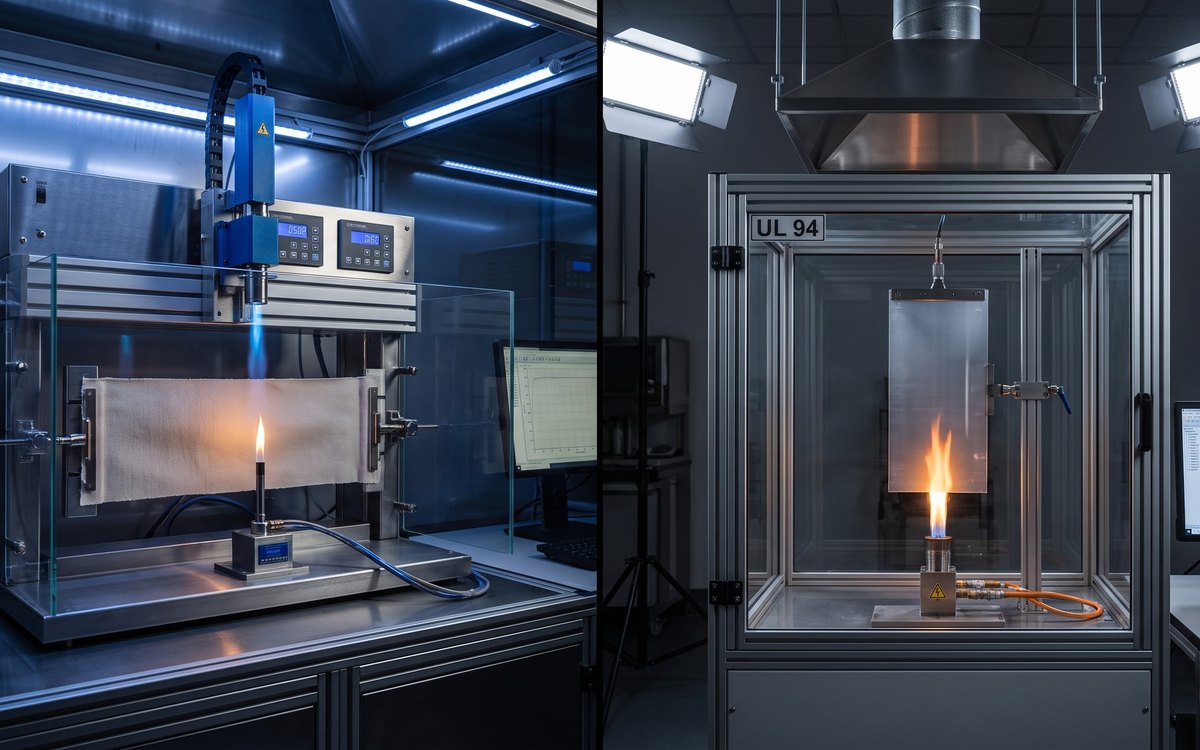
Choose a UL 94 flammability tester when the requirement concerns the burning characteristics of plastic materials used in appliance or device parts. Confirm the expected classification—such as HB, V-0, V-1 or V-2—because horizontal and vertical procedures use different specimen positions, flame applications and pass criteria.
UL 94 is a group of small-scale tests used to classify how plastic specimens behave after exposure to a controlled ignition flame. It does not, by itself, predict the behavior of an entire finished product in a full-scale fire.
For the commonly used vertical procedure, UL Solutions lists a 20 mm flame applied twice for 10 seconds. Its published criteria include:
- V-0: each afterflame period must be no more than 10 seconds.
- V-1: each afterflame period must be no more than 30 seconds.
- V-2: each afterflame period must be no more than 30 seconds, but flaming droplets may ignite the cotton indicator.
- Total afterflame time across 10 flame applications is limited to 50 seconds for V-0 and 250 seconds for V-1 or V-2.
For HB testing, UL Solutions reports maximum burning rates of 40 mm/min for specimens 3–13 mm thick and 75 mm/min for specimens thinner than 3 mm, subject to the full method and applicable conditions.
Apple Electroniks lists a UL94 Flammability Tester for laboratories evaluating applicable plastic specimens. Before ordering, confirm the required UL 94 procedure, specimen thicknesses, gas specification and desired classifications.
When Is an NFPA 701 Tester Appropriate?
Choose an NFPA 701 tester when the requirement is to assess flame propagation of textiles or films used in applications such as curtains, draperies and decorative materials within the standard’s scope. The test method must be selected according to the material construction and end use; NFPA 701 is not interchangeable with an apparel or plastics test.
NFPA 701 is a standard containing fire-test methods for measuring flame propagation in specified textiles and films. It includes more than one method, so an enquiry stating only “NFPA 701 machine” may not provide enough information to configure the apparatus.
NFPA identifies the standard’s central purpose as assessing flame propagation under prescribed fire-test conditions. The current project should reference the exact edition named by the authority, customer or laboratory quality system. The NFPA record also identifies a 2023 edition, for which NFPA issued published errata affecting referenced provisions.
When evaluating an NFPA 701 system, verify:
- Supported NFPA 701 test method
- Specimen holder and chamber dimensions
- Burner construction and flame controls
- Specimen conditioning requirements
- Timing and observation arrangements
- Method for recording specimen mass or damaged behavior where required
- Exhaust and safe combustion-gas handling
Apple Electroniks lists the NFT701 NFPA 701-1 Flammability Tester in its product range. The buyer should provide the material’s description, mass per unit area, construction and intended use so the required method can be checked before quotation.
When Should ASTM D1230 Testing Be Used?
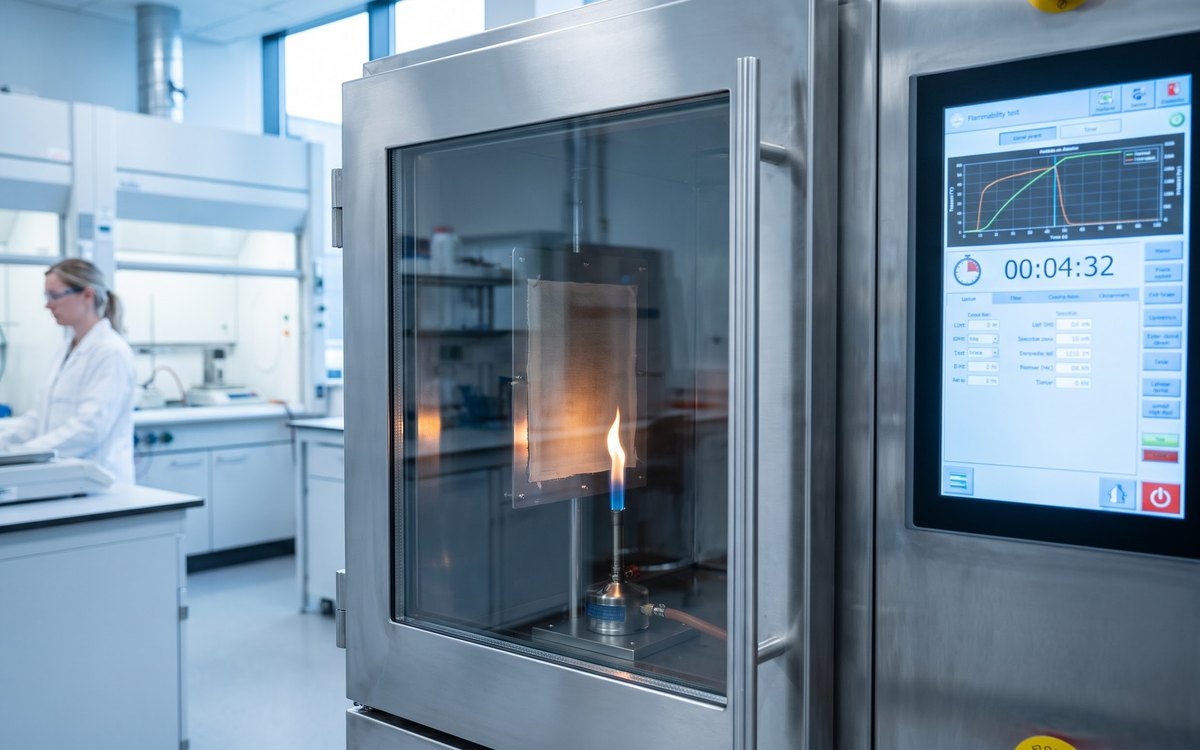
ASTM D1230 should be considered when evaluating the flammability of consumer textile fabrics intended for apparel, subject to the exclusions and requirements in the applicable edition. The method positions the specimen at 45 degrees and measures flame-spread behavior after controlled ignition, making it different from NFPA 701 curtain and film testing.
ASTM D1230 is a test method for evaluating the flammability of apparel textiles using a specimen mounted at a 45-degree angle. It is not the correct default for every textile product. Children’s sleepwear, protective clothing and furnishings may be governed by different requirements.
The U.S. Consumer Product Safety Commission’s clothing standard, 16 CFR Part 1610, uses a 45-degree test approach to classify clothing textiles. In its 2023 final rule, the CPSC incorporated ASTM D1230-22 with specified modifications, and the updated rule became effective on April 22, 2024. Federal Register: Standard for the Flammability of Clothing Textiles
The federal classification system distinguishes:
- Class 1: normal flammability and generally acceptable for clothing
- Class 2: intermediate flammability, applicable only to raised-surface fabrics
- Class 3: rapid and intense burning and considered dangerously flammable
Laboratories considering the Apple Electroniks AFT45 Automatic Flammability Tester should confirm whether testing is required to ASTM D1230, 16 CFR Part 1610 or another 45-degree method. Automation can assist with repeatable timing and operation, but it does not remove the need for correct specimen preparation, conditioning and operator observation.
What Is the Difference Between Horizontal and Vertical Testing?
Horizontal testing measures burning behavior while the specimen extends sideways, whereas vertical testing exposes a specimen positioned upright and may evaluate self-extinguishing time, afterglow and flaming droplets. Because flame and hot gases rise, orientation changes heat transfer and burning behavior; a horizontal rating cannot be treated as an equivalent vertical rating.
In UL 94 HB testing, the result is based principally on flame progression and calculated burning rate. UL Solutions specifies a 30-second flame application with a nominal 20 mm flame for the published HB procedure. The measured burning distance and specimen thickness contribute to the classification.
For the UL 94 V method, the specimen is vertical and receives two 10-second flame applications. The laboratory observes afterflame, afterglow and whether flaming particles ignite a cotton indicator placed below the specimen.
This distinction leads to an important procurement rule: choose by test method, not by the assumption that a vertical tester is simply a horizontal tester turned upright.
A configurable horizontal/vertical chamber may be appropriate when it includes:
- Standard-specific specimen holders
- Precisely adjustable burner position
- Verified flame-height setting
- Accurate application and afterflame timers
- Observation access without disrupting airflow
- Sufficient chamber volume and exhaust control
- Accessories required by each intended classification
Apple Electroniks lists both a UL 94 tester and an HFT Horizontal Flammability Tester. Buyers should specify the exact standard because “horizontal flammability” can refer to different procedures across plastics, textiles and automotive materials.
Which Equipment Specifications Should You Verify?
Verify that the equipment reproduces the selected standard’s burner, flame dimensions, specimen position, timing, chamber, conditioning and observation requirements. Also assess calibration support, gas compatibility, exhaust provisions, operator protection and documentation. A machine is suitable only when its complete configuration matches the required method and edition.
Use this procurement checklist:
- Standard compatibility: Record the full standard number, test method and edition.
- Specimen capacity: Confirm dimensions, thickness, material form and holder type.
- Ignition system: Check burner type, gas requirement, flame angle and flame-height adjustment.
- Timing functions: Confirm resolution and control of ignition, afterflame and afterglow timing.
- Chamber design: Verify airflow control, visibility and corrosion- or heat-resistant construction.
- Safety provisions: Review gas shutoff, exhaust connection and flame containment.
- Documentation: Request operating instructions, calibration records and a scope-of-supply list.
- Service support: Confirm installation, training, maintenance and replacement-part availability.
Numerical details must match the intended procedure. For example, UL publishes a 50 W, 20 mm flame for the V-0/V-1/V-2 method and a 500 W, 125 mm flame for 5VA/5VB testing. UL notes that the 5V ignition source is approximately five times more severe than the source used for HB and the standard vertical classifications. UL Solutions: Difference in UL 94 Test Methods
Do not assume one burner configuration covers both procedures without written confirmation.
How Should You Prepare an Equipment Enquiry?
Prepare an equipment enquiry by sending the manufacturer the standard and edition, required classification, material, specimen dimensions, expected test volume, available utilities and reporting needs. This information enables Apple Electroniks to identify the appropriate instrument, fixtures and accessories while reducing the risk of receiving an incomplete or unsuitable configuration.
Include the following details:
- Standard: UL 94, NFPA 701, ASTM D1230 or another named method
- Required classification or test method
- Product and material description
- Specimen dimensions and thickness range
- Number of tests expected per day
- Available gas, electrical supply and exhaust facilities
- Manual or automatic operation preference
- Installation, training and calibration requirements
- Destination and applicable laboratory accreditation needs
For UL 94 enquiries, specify whether you need HB, V-0/V-1/V-2, 5VA/5VB, VTM or foam classifications. UL recognizes 12 classifications, and the relevant fixture and ignition arrangement vary across these groups.
For NFPA 701, identify the method and material construction. For apparel fabrics, clarify whether the requirement is ASTM D1230, 16 CFR Part 1610, or both with the regulation’s stated modifications.
Explore flammability testing equipment from Apple Electroniks or send your testing requirement to Apple Electroniks for configuration guidance.
Explore More
- Flammability testing equipment for material safety → Product category
- Testing equipment for textile laboratories → Fiber, fabric and yarn testing
- Surface wear and abrasion testing equipment → Surface and abrasion testing
- Request a flammability tester quotation → Contact Apple Electroniks
Frequently Asked Questions
Which flammability tester is suitable for plastics?
A UL 94 tester is commonly selected for plastics used in device and appliance parts. Confirm whether the required result is HB, V-0, V-1, V-2, 5VA, 5VB, VTM or a foam classification.
What is the difference between UL 94 and NFPA 701?
UL 94 principally classifies the burning characteristics of plastic materials, while NFPA 701 assesses flame propagation in specified textiles and films. Their results are not interchangeable.
Is ASTM D1230 the same as NFPA 701?
No. ASTM D1230 evaluates apparel textile flammability using a 45-degree procedure, while NFPA 701 covers flame propagation testing for specified textiles and films such as draperies and decorative materials.
Is vertical flammability testing more demanding than horizontal testing?
Vertical orientation can expose the specimen more directly to rising flame and heat, but “more demanding” depends on the specific standard and criteria. A horizontal rating should never be converted into a vertical rating.
Can one machine perform horizontal and vertical tests?
Some chambers can support multiple orientations when equipped with the correct burners, fixtures and controls. Suitability must be verified separately for every standard and test method.
Does passing a small-scale test mean a product is fireproof?
No. A small-scale flammability result describes behavior under defined laboratory conditions. It does not mean the material is fireproof or predict every full-scale fire scenario.
What information should I send before requesting a quotation?
Send the standard and edition, required classification, material, specimen dimensions, expected workload, available utilities and required accessories. This allows Apple Electroniks to recommend an appropriate configuration.
Explore the relevant Apple Electroniks testing equipment, or contact us with your required standard and specimen details.