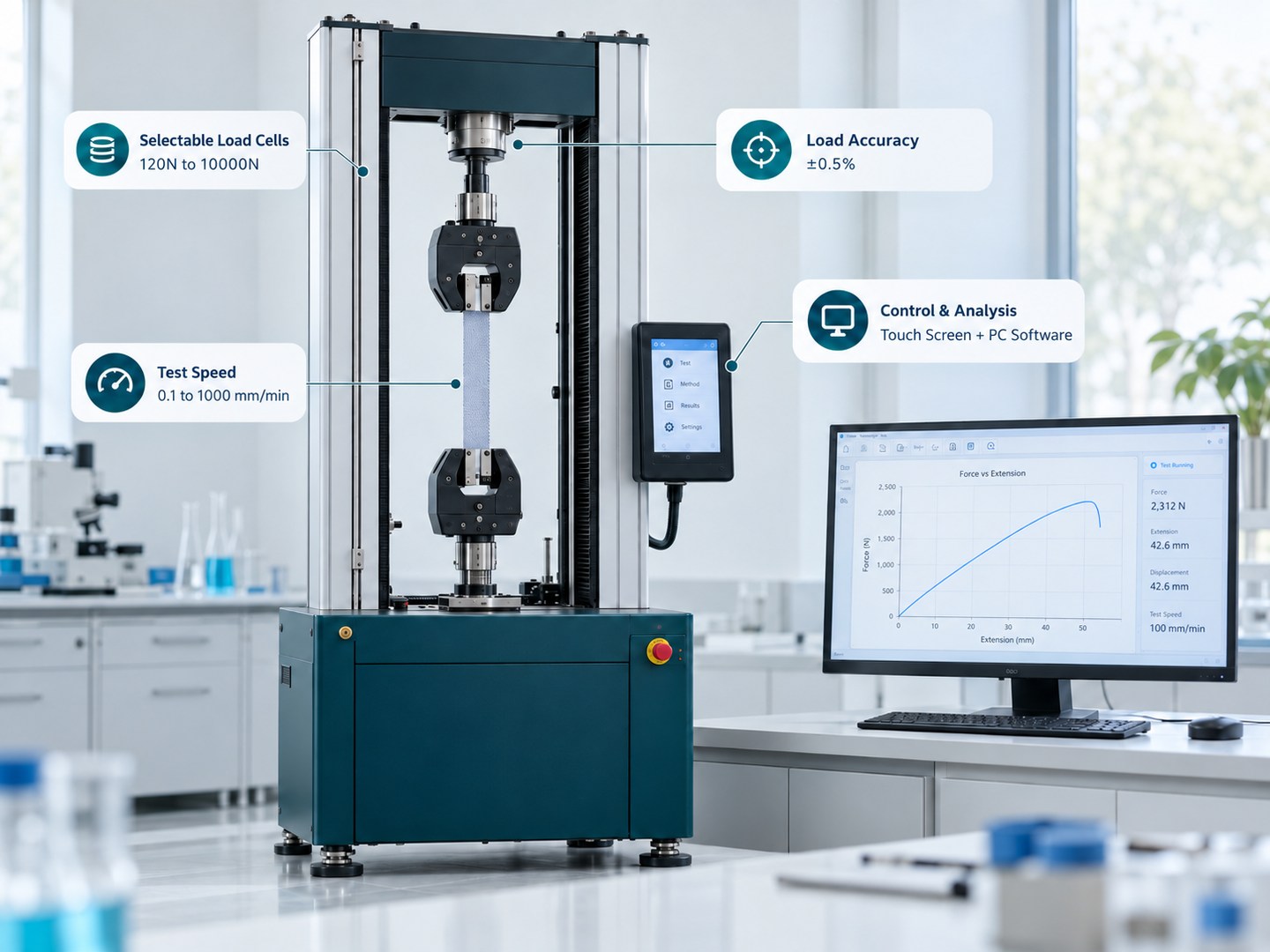
Universal Testing Machine: How to Choose the Right UTM for Your Laboratory
Learn how to select the right universal testing machine by comparing load capacity, measurement accuracy, testing standards, grips, software, and calibration requirements.
SUMMARY: A universal testing machine (UTM) measures the mechanical behavior of materials under controlled loading. Choosing the right machine requires matching its force capacity, accuracy, testing speed, fixtures, and supported standards to your laboratory's specimens. For textile and yarn laboratories, Apple Electroniks offers the UTM 5K with configurable load cells and software-based test analysis.
Choosing a universal testing machine starts with understanding what your laboratory needs to measure—not simply selecting the highest force capacity available.
Whether you test fabrics, yarns, plastics, packaging materials, or industrial straps, the right UTM should deliver repeatable measurements, support your required standards, and accommodate your specimens without unnecessary equipment costs.
This 2026 guide explains the technical specifications that matter and how to evaluate a machine before purchasing it.
What Is a Universal Testing Machine, and What Does It Measure?
A universal testing machine (UTM) is a laboratory instrument that applies controlled force or displacement to a specimen and measures its mechanical response. Depending on its configuration, it can evaluate tensile strength, elongation, compression, peeling, and related properties. The applicable test standard determines which measurements and procedures are required.
During a tensile test, the machine grips a specimen and pulls it at a controlled rate while recording the applied force and extension.
Common measurements include:
- Breaking force: The force at which a specimen ruptures, usually expressed in newtons (N).
- Elongation: The increase in specimen length during loading.
- Tensile stress: The tensile force divided by the appropriate cross-sectional area.
- Strain: The relative change in a specimen's gauge length.
- Yield behavior: The material's response as it begins to deform permanently, where applicable.
A UTM may operate using the Constant Rate of Extension (CRE) principle, which controls the extension rate while measuring force continuously.
For example, ISO 2062:2009 specifies CRE-based measurement of breaking force and elongation for eligible textile yarns. It defines four specimen preparation and testing methods, designated A through D.
UTMs are widely used in manufacturing quality control, textile laboratories, materials research, and product development.
However, the word universal does not mean that every machine can perform every mechanical test. The frame, load cell, fixtures, software, and measurement system must all suit the intended application.
How Do You Choose the Right UTM Load Capacity?
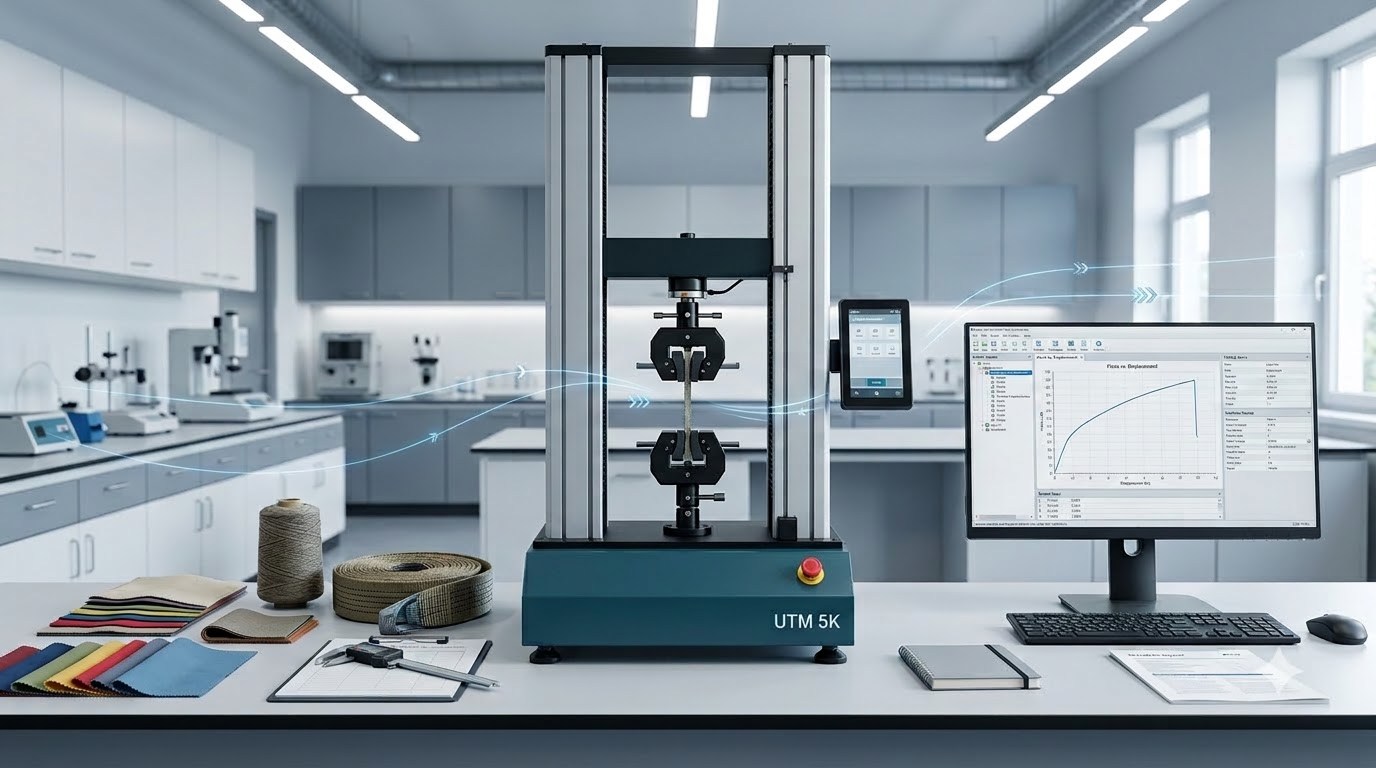
Choose UTM load capacity by estimating the maximum force your specimens will experience and selecting a load cell with suitable measurement performance and overload margin. A higher capacity is not automatically better: testing delicate yarn on an unnecessarily large load cell may make low-force measurement more difficult to verify.
Load capacity is the maximum rated force a testing system is designed to measure or apply within its specified operating conditions.
For example, a 5 kN load capacity corresponds to 5,000 N.
Apple Electroniks lists six selectable load cell options for its UTM 5K: 120 N, 500 N, 1,000 N, 2,000 N, 5,000 N, and 10,000 N. The appropriate configuration depends on the specimens and test procedures.
UTM capacity selection guide
| Testing application | Capacity options to evaluate | Selection consideration |
|---|---|---|
| Single yarns and delicate materials | 120–500 N | Low-force measurement performance |
| Routine fabric tensile testing | 1–2 kN | Expected fabric breaking force |
| Heavy fabrics and industrial straps | 5 kN or higher | Peak force and fixture rating |
| Plastics and engineered materials | Specimen-dependent | Cross-section, strength, and method |
These are illustrative capacity options, not fixed requirements for each material.
Suppose a specimen typically breaks at 600 N. A 1,000 N or 2,000 N load cell may be worth evaluating, provided its verified operating range and safety margin meet the application.
Before ordering, determine:
- The expected minimum and maximum breaking forces.
- The force range requiring verified accuracy.
- Whether additional load cells are needed for different materials.
- The maximum permissible force of the frame and grips.
Importantly, a 10,000 N load cell option should not be interpreted as proof that every UTM 5K frame and fixture is rated for 10 kN. Confirm the complete system rating with Apple Electroniks.
Which UTM Specifications Matter Most for Accuracy?
The most important UTM specifications are force accuracy, verified measuring range, speed accuracy, displacement measurement, gauge length, and fixture alignment. These determine whether the equipment can produce meaningful results for a particular test method. A high-resolution display alone does not establish that the instrument measures accurately.
Evaluate the following specifications before comparing UTM models.
Force measurement accuracy
The Apple Electroniks UTM 5K lists load measurement accuracy of ±0.5% of the indicated value.
At an indicated force of 1,000 N, 0.5% corresponds to 5 N. This illustrates the stated accuracy specification, not the complete measurement uncertainty of a calibrated test.
Force resolution
The published force resolution is 0.1 N.
Resolution describes the smallest indicated increment. It should not be confused with measurement accuracy or the lowest force at which the machine is verified.
Testing speed
The UTM 5K lists adjustable jog and return speeds between 0.1 and 1,000 mm/min, with stated speed accuracy better than ±1%.
The required testing speed must be selected according to the relevant standard rather than operator preference.
Gauge length and displacement
The instrument lists an adjustable gauge length of 25–500 mm and displacement resolution of 0.01 mm.
For precise strain or modulus measurements, crosshead displacement may be insufficient. An appropriate extensometer and its verification may be necessary under ASTM E83-25.
Specimen alignment
Poor alignment or slipping grips can affect measured force and elongation even when the load cell performs correctly.
Ask suppliers to demonstrate results using representative specimens, including thin materials, high-elongation samples, and specimens likely to slip or break near the grips.
The best machine is not necessarily the one with the greatest number of specifications. It is the machine whose verified performance matches your actual testing requirements.
Which Testing Standards and Grips Should Your UTM Support?
Select a universal testing machine around the test standards your customers, laboratory, or quality department requires. Standards define the specimen, testing procedure, and measurement conditions. Correct grips and fixtures are essential because a machine's general tensile-testing capability does not automatically establish compliance with every method.
Common UTM testing standards
| Standard | Testing application | Key requirement |
|---|---|---|
| ISO 13934-1:2013 | Textile fabric tensile testing | Maximum force and elongation by strip method |
| ISO 2062:2009 | Yarn strength testing | Single-end breaking force and elongation |
| ASTM D5034-21(2025) | Fabric grab testing | Suitable grab-test grips and procedure |
| ASTM D5035-11(2024) | Fabric strip testing | Strip specimen preparation and gripping |
| ASTM D638-22 | Plastic tensile testing | Suitable dumbbell specimens and fixtures |
The distinction between strip and grab testing is important. Their specimen geometries and gripping arrangements differ, so results should not be treated as interchangeable.
Similarly, ASTM D638 covers tensile testing of specified plastic specimens. For thin plastic sheeting, including films below 1 mm, the standard points to ASTM D882 as the preferred method.
How to choose UTM grips
Common configurations include:
- Strip grips: For suitable fabric strip specimens.
- Grab grips: For textile grab-test procedures.
- Yarn grips: For reducing slippage and grip-related specimen damage.
- Peel fixtures: For bonded or laminated materials.
- Dogbone grips: For compatible plastic tensile specimens.
Apple Electroniks lists strip and grab mechanical grips in the UTM 5K standard configuration, with additional test-purpose grips available as options.
Before purchasing, share the exact standard designation, specimen dimensions, required test speed, and expected force range with the supplier.
A manufacturer's list of supported standards should be checked against the purchased machine configuration and the laboratory's actual method requirements.
How Do You Verify UTM Calibration and Measurement Reliability?
Verify UTM reliability by reviewing calibration certificates, measurement traceability, applicable verification standards, and results across the forces your laboratory will use. Calibration is necessary for confidence in the reported force, while machine configuration, specimen preparation, and operating procedures also influence the validity of testing results.
Calibration is the process of establishing the relationship between an instrument's indications and known reference values under specified conditions.
Three important references are:
ASTM E4-24: Procedures for force calibration and verification of testing machines.
ISO 7500-1:2018: Calibration and verification of force-measuring systems for applicable static tension and compression testing machines. ISO confirmed this edition in 2026.
ISO/IEC 17025:2017: Requirements for competent and consistently operated testing and calibration laboratories.
ASTM E4 emphasizes traceability of force measurements to the International System of Units (SI).
What should you request from the supplier?
Ask for documentation that identifies:
- The machine and load cell serial numbers.
- The calibration method and measurement points.
- The verified operating range.
- Measurement uncertainty and traceability information.
- Applicable acceptance criteria and verification results.
- Recalibration recommendations and available service support.
- A supplied calibration weight is useful, but its inclusion alone is not evidence of a traceable system calibration.
Calibration frequency should follow the laboratory's usage, historical stability, applicable procedures, and accreditation obligations rather than an arbitrary universal schedule.
For laboratories operating under ISO/IEC 17025, documented equipment control and competent technical procedures are especially important. Purchasing a UTM does not itself make a laboratory accredited.
Is the Apple Electroniks UTM 5K Right for Your Laboratory?
The Apple Electroniks UTM 5K is worth considering for laboratories primarily testing textiles, yarns, fabric assemblies, straps, and compatible flexible materials. Its published configuration combines CRE-based testing, selectable load cells, touchscreen control, and PC software. Suitability for a specific standard depends on the selected fixtures and verified system performance.
Apple Electroniks UTM 5K: Key specifications
| Specification | Published value |
|---|---|
| Load cell options | 120–10,000 N |
| Load accuracy | ±0.5% of indicated value |
| Force resolution | 0.1 N |
| Adjustable speed range | 0.1–1,000 mm/min |
| Displacement resolution | 0.01 mm |
| Adjustable gauge length | 25–500 mm |
| Equipment weight | 120 kg |
| Power requirement | 220 V AC, 50 Hz |
| Dimensions | 380 × 480 × 1,450 mm |
What makes this configuration useful?
The machine offers touchscreen and computer-based operation, with software functions for force–extension graphs, breaking loads, elongation measurements, and data reporting.
The manufacturer also lists 11 test functions, covering applications such as tensile testing, peeling, tearing, seam slippage, elastic recovery, and yarn strength testing, subject to the necessary accessories and methods.
Reports can be exported to Excel, Word, or image formats.
The product page lists PC software in the standard configuration, while the computer hardware and extensometer are optional. Confirm the exact contents of the quotation.
The listed installation dimensions and 120 kg weight should also be checked against your laboratory's floor space and handling arrangements.
For laboratories needing calibrated metal tensile testing, specialized compression testing, or advanced modulus measurements, request confirmation that the offered frame, sensors, fixtures, and software satisfy those requirements.
Explore additional fabric, fiber, and yarn testing equipment from Apple Electroniks when evaluating a complete textile laboratory setup.
How Should You Select and Purchase a UTM in 2026?
The most effective UTM purchasing process begins with a written testing requirement, followed by technical verification using representative samples. Compare suppliers on compliance with your methods, verified measurement performance, accessories, software, installation, calibration, and service—not only the initial machine price.
Seven steps to selecting the right UTM
Identify your materials. List fabrics, yarns, plastics, films, straps, or other specimens your laboratory will test.
Specify the required standards. Record the exact ASTM, ISO, or customer-specific test methods, including their editions.
Estimate testing forces. Select a suitable load cell and confirm the frame's rated capacity and verified measuring range.
Check grips and extensometers. Ensure the quotation includes everything needed to secure and measure your specimens.
Evaluate software. Request a demonstration of test setup, live graphs, calculated parameters, report generation, and data exports.
Verify calibration and installation. Confirm documentation, service availability, power supply, and operator training arrangements.
Request a specimen demonstration. Compare actual test results and observe specimen gripping, break location, and report quality.
Final buying recommendation
For textile and yarn quality-control applications, a configurable CRE-based UTM is a practical starting point. The appropriate machine should be chosen according to actual force levels, required standards, and available accessories.
Apple Electroniks offers the UTM 5K Universal Testing Machine for these applications.
Contact Apple Electroniks with your specimen material, applicable test standard, expected breaking force, and required output parameters to request the most suitable UTM configuration and quotation.
Frequently Asked Questions About Universal Testing Machines
The right universal testing machine depends on the specimen, maximum testing force, required standards, and measurement accuracy. Laboratories should also evaluate calibration, fixtures, extensometers, and software before purchasing. These answers address common questions about UTM selection, capacity, testing applications, and operational requirements.
What is a universal testing machine used for?
A universal testing machine measures how materials respond to controlled loading. Depending on the equipment and fixtures, it can assess breaking force, elongation, tensile behavior, compression, and related mechanical properties.
Is a 5 kN universal testing machine enough for laboratory testing?
A 5 kN UTM can be suitable when specimen forces remain within its verified measuring and operating ranges. It may be appropriate for many textile and flexible-material tests, but higher-force applications require an appropriately rated system.
What is the difference between a UTM and a tensile testing machine?
A tensile testing machine is designed to measure material behavior under tension. A universal testing machine may support additional test types, such as compression or peeling, when equipped with the appropriate frame, accessories, and control systems.
Can a universal testing machine test fabrics and yarns?
Yes. An appropriately configured UTM can perform fabric and yarn tensile tests under methods such as ISO 13934-1 and ISO 2062. The required grips, load capacity, and testing settings must match the method.
Can the Apple Electroniks UTM 5K test plastics?
Apple Electroniks lists ASTM D638 plastic tensile testing as an application with a special dogbone specimen fixture. Confirm the specimen dimensions, force requirements, strain measurement system, and optional accessories before purchasing.
What does ±0.5% load accuracy mean in a UTM?
It means the manufacturer's stated force accuracy is within 0.5% of the indicated force under its specified conditions. At an indicated 200 N, that percentage corresponds to 1 N; actual verified performance should be checked in the calibration documentation.
How often should a universal testing machine be calibrated?
Calibration frequency depends on usage, instrument stability, laboratory procedures, and applicable accreditation requirements. Laboratories should establish a documented schedule and perform additional verification when equipment performance is in doubt.
What determines the price of a universal testing machine?
UTM pricing depends on load capacity, frame configuration, measurement systems, grips, software, calibration, installation, and service requirements. Request an itemized quotation based on your test methods rather than comparing machine prices without considering the included accessories.
Related Apple Electroniks Resources
- UTM 5K Universal Testing Machine
- Fabric, Fiber & Yarn Testing Equipment
- Tensile Breaking Strength Guide
For equipment configuration and quotations, contact Apple Electroniks with your material, required method and expected force range.