What Is Tensile Breaking Strength? Fabric Testing Methods, Standards & Equipment
Understand how fabric tensile breaking strength is measured, which ISO and ASTM standards apply, and how to select the right testing equipment for reliable laboratory results.
SUMMARY: Tensile breaking strength is the force required to break a fabric specimen when it is pulled under controlled testing conditions. Laboratories measure it using tensile testing equipment and standardized methods such as ISO 13934-1, ASTM D5034 and ASTM D5035. Accurate testing helps textile manufacturers evaluate material performance, verify product specifications and maintain consistent quality.
What Is Tensile Breaking Strength in Fabrics?
Tensile breaking strength is the force needed to rupture a fabric specimen when it is pulled in one direction under defined testing conditions. It is generally reported as breaking force in newtons (N), together with the specimen dimensions, fabric direction and test method. It describes resistance to pulling forces rather than tearing, abrasion or puncture.
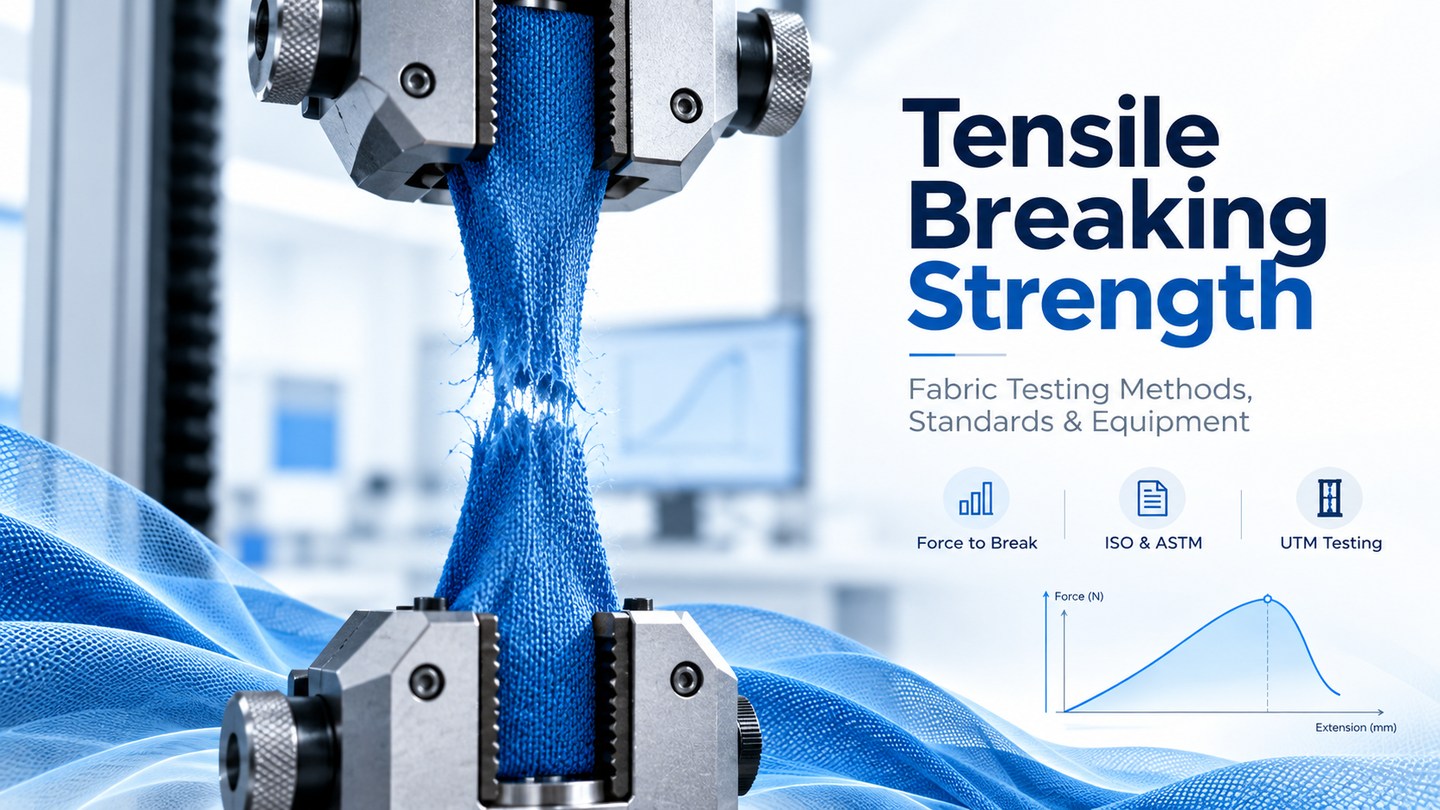
In textile quality control, a tensile testing machine gradually extends a fabric specimen while measuring the applied force. The resulting force–extension curve shows how the material behaves as the load increases.
Under ISO 13934-1:2013, the strip test determines maximum force and elongation at maximum force. These values are important because the highest recorded force does not always occur at the exact moment of final specimen rupture.
Why Is Tensile Breaking Strength Important?
Tensile breaking strength helps manufacturers assess whether a material can tolerate the pulling forces expected during production, handling and normal use.
Common applications include:
- Apparel: Evaluating resistance to tensile loading in garments.
- Upholstery: Assessing the strength of furniture covering materials.
- Technical textiles: Evaluating performance in industrial fabric applications.
- Bags and webbing: Checking resistance to loading during use.
- Textile production: Comparing batches against customer specifications.
Fabric direction also matters. Woven fabrics contain warp yarns, running lengthwise, and weft yarns, running across the fabric.
For example, a laboratory might record 420 N in the warp direction and 310 N in the weft direction for the same material. These are illustrative results, not universal performance benchmarks.
Key takeaway: A valid breaking strength result must identify how the specimen was tested. A numerical value without its direction and method can be misleading.
Which Methods Are Used to Test Fabric Tensile Breaking Strength?
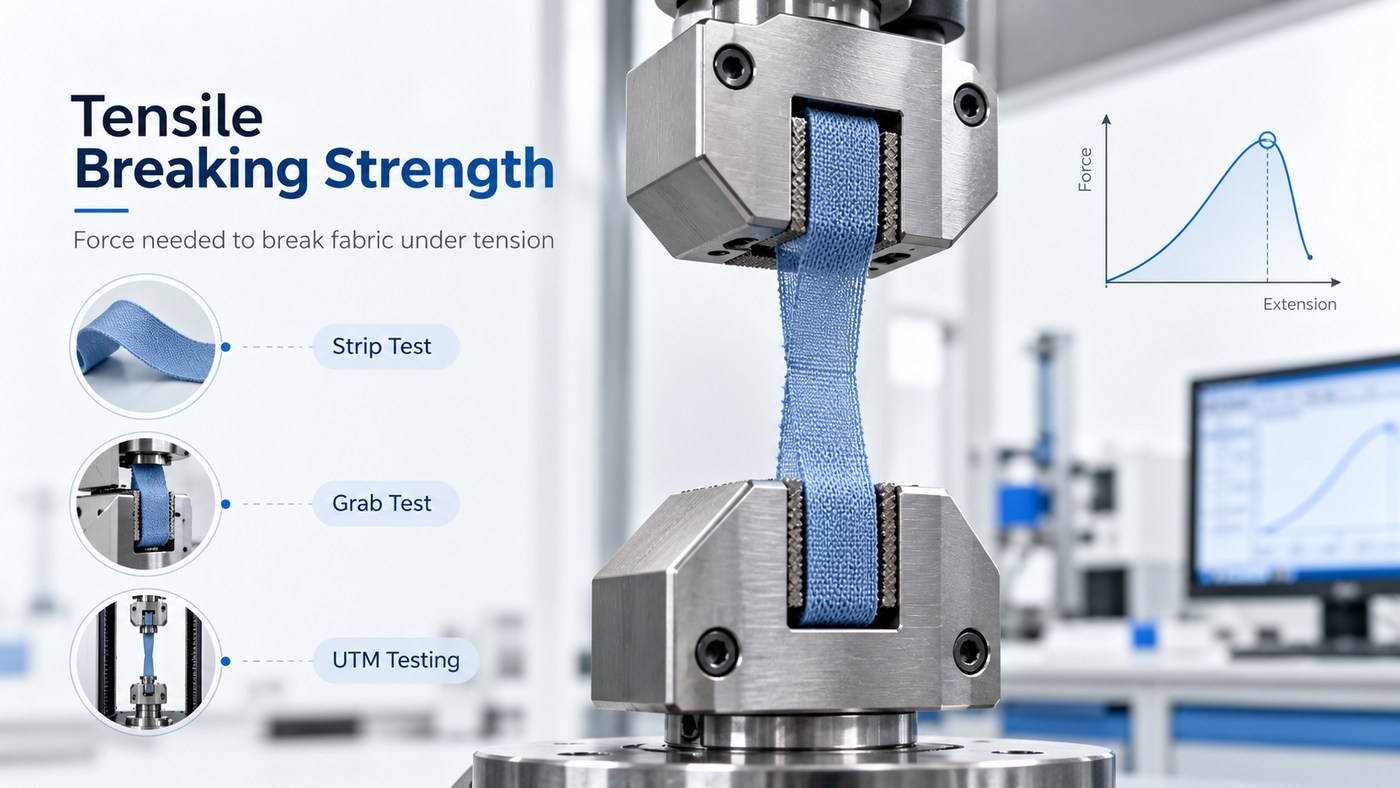
Fabric tensile breaking strength is commonly measured using strip or grab testing methods. In a strip test, the specimen is gripped across its full prepared width. In a grab test, only a central portion is gripped, allowing adjacent fabric to influence the result. The appropriate method depends on the textile and applicable standard.
Strip Test vs. Grab Test
| Testing feature | Strip test | Grab test |
|---|---|---|
| Specimen gripping | Entire prepared width | Central portion of specimen |
| Main measurement | Maximum tensile force and elongation, where specified | Breaking or maximum force; elongation where specified |
| Common standards | ISO 13934-1, ASTM D5035 | ISO 13934-2, ASTM D5034 |
| Typical applications | Woven fabric quality testing | Commercial fabric acceptance testing |
| Main consideration | Specimen width and edge preparation | Effect of adjacent fabric on measured force |
Strip Tensile Test
The strip test uses a prepared fabric specimen positioned between two grips. The machine extends the material until the required maximum force or breaking endpoint is reached.
ASTM D5035 distinguishes raveled-strip and cut-strip procedures. Raveled strips are particularly relevant to woven textiles, while cut strips are applicable to certain nonwoven, felted and coated materials.
According to ASTM D5035-11(2024), this method is not recommended for knitted fabrics or other fabrics with high stretch exceeding 11%.
Grab Tensile Test
The grab test clamps only part of the specimen width. Surrounding yarns can contribute to the resistance measured during the test.
According to ASTM D5034-21(2025), grab testing is used for acceptance testing of many commercial woven and nonwoven fabrics.
Which Method Should a Laboratory Choose?
Choose the method specified by the customer, product specification or applicable testing standard.
Important: ASTM D5034 states that there is no simple relationship between grab and strip test results. Their breaking-force values should not be directly substituted for one another.
Which ISO and ASTM Standards Apply to Tensile Breaking Strength?
The main textile tensile testing standards are ISO 13934-1, ISO 13934-2, ASTM D5034 and ASTM D5035. Each defines a particular testing approach, specimen requirements and reporting conditions. Nonwoven fabrics and yarns may require separate standards, so laboratories should match the method to the material before testing.
Major Textile Tensile Testing Standards
| Standard | Testing method | Primary application |
|---|---|---|
| ISO 13934-1:2013 | Strip test | Maximum force and elongation at maximum force of mainly woven fabrics |
| ISO 13934-2:2014 | Grab test | Maximum force of mainly woven fabrics |
| ASTM D5034-21(2025) | Grab and modified grab | Breaking strength and elongation of textile fabrics |
| ASTM D5035-11(2024) | Raveled-strip and cut-strip | Breaking force and elongation of textile fabrics |
| ISO 9073-3:2023 | Nonwoven strip test | Breaking force and elongation of nonwovens |
| ISO 2062:2009 | Single-end yarn tensile test | Breaking force and elongation of yarns |
| ASTM D2256/D2256M-21 | Single-strand tensile test | Mechanical properties of textile yarns |
Standard editions were checked against the issuing organizations' published information in October 2026.
Why Does the Correct Standard Matter?
Different methods can produce different values for the same fabric because specimen geometry, gripping configuration and extension conditions vary.
For example, ISO 9073-3:2023 specifies two nonwoven specimen-width options: 25 mm and 50 mm. The selected option must be reported so results can be interpreted correctly.
ISO 13934-1:2013 and ISO 13934-2:2014 remain current published editions according to the International Organization for Standardization.
Laboratories should also distinguish a test method from an acceptance requirement. A standard explains how to perform a test, but it does not necessarily establish the minimum breaking force every finished product must meet.
Such limits generally come from customer specifications, applicable product requirements or an agreed quality-control plan.
How Is a Fabric Tensile Breaking Strength Test Performed?
Fabric tensile breaking strength testing involves preparing standardized specimens, conditioning them, securing them in a tensile testing machine and applying a controlled extension until the required endpoint is reached. The selected standard determines the gripping method, specimen dimensions, speed, pretension, replicate requirements and reporting procedure needed for comparable results.
Step-by-Step Fabric Tensile Testing Procedure
Select the testing standard. Identify whether the material requires a strip, grab, nonwoven or another specialized tensile method.
Prepare the specimens. Cut samples to the geometry required by the standard. Where applicable, prepare separate warp and weft specimens.
Condition the material. Stabilize specimens in the specified testing atmosphere before measurement.
Configure the testing machine. Select a suitable calibrated load cell, gauge length, test speed, grips and pretension settings.
Secure the specimen. Align the material between the grips without twisting, unintended stretching or excessive clamping damage.
Perform the tensile test. Start the constant-rate-of-extension test and record the force–extension response until the specified endpoint.
Evaluate and report results. Review the failure location, calculate required statistics and document testing conditions.
Why Is Fabric Conditioning Essential?
Temperature and moisture conditions can influence the mechanical behavior of textile materials.
ISO 139:2005 and Amendment 1:2011 establish a standard atmosphere of 20°C and 65% relative humidity, with specified tolerances of ±2°C and ±4% RH. Alternative atmospheres may be used when permitted and agreed upon.
Conditioning requirements must follow the adopted test method rather than a fixed period chosen arbitrarily.
What Can Make a Test Invalid?
Specimen slippage, jaw damage, incorrect alignment and unsuitable grips can distort results.
If the specimen fails prematurely at the clamping point, laboratory personnel should investigate and apply the method's requirements for rejecting or repeating a test.
Consistent preparation is essential for obtaining defensible quality-control data.
How Are Tensile Breaking Strength Results Calculated and Interpreted?
Tensile breaking strength results are interpreted using the recorded force, extension and specified test endpoint. Breaking force is reported in newtons, while elongation is generally expressed as a percentage of the original gauge length. Results should be evaluated alongside the testing method, specimen direction, width and failure characteristics.
Breaking Force
Breaking force is the tensile load recorded when the specimen breaks.
For example, if a fabric specimen ruptures under a measured load of 420 N, its breaking force is 420 N under the stated test conditions.
However, a standard that specifies maximum force requires the highest recorded force to be reported, which may differ from the force at final rupture.
Elongation at Break
Elongation indicates how much the specimen extends relative to its original gauge length.
Formula:
Elongation at break (%) = (Extension at break ÷ Original gauge length) × 100
Illustrative example:
Original gauge length: 100 mm
Extension at break: 18 mm
Elongation at break: 18%
These values are an explanatory calculation, not published test data.
For methods such as ISO 13934-1, use elongation at the specific endpoint required by the standard—in that case, maximum force.
How Should Results Be Reported?
A useful laboratory report should identify:
- Maximum force or breaking force, as applicable, in N
- Elongation at the specified endpoint, in %
- Testing standard and edition
- Warp or weft direction, if applicable
- Specimen width and gauge length
- Conditioning and test conditions
- Number of valid specimens, average and variability
A force result in N is not automatically equivalent to tensile stress in MPa. Calculating stress requires an appropriately defined cross-sectional area.
Yarn testing may instead use tenacity, such as centinewtons per tex, to compare yarns with different linear densities.
What Factors Affect Fabric Tensile Breaking Strength?
Fabric tensile breaking strength is affected by fiber properties, yarn construction, fabric structure, finishing, moisture and testing conditions. Materials with different weave structures or yarn orientations may respond differently to the same applied force. Controlled testing minimizes avoidable variation, helping laboratories distinguish genuine material differences from testing errors.
Major Factors Influencing Test Results
Fiber and yarn properties
Fiber composition, yarn linear density, twist and yarn uniformity influence how tensile force is transferred through a material.
Fabric construction
Weave type, thread density and yarn arrangement determine how the fabric responds to extension in different directions.
Warp and weft direction
Woven fabrics may show different breaking forces along their warp and weft directions. Results should be recorded separately when the test requires both.
Moisture and conditioning
Some fibers change their mechanical behavior when wet. Dry and wet test results should therefore be compared only under clearly documented conditions.
ASTM D1776/D1776M-20(2024), the standard practice for conditioning and testing textiles, addresses conditioning when required by a test method.
Machine settings and sample preparation
Crosshead speed, gauge length, clamping pressure and specimen edge preparation can influence measured results.
For instance, poorly chosen grips may cause slippage before the actual material breaking force is reached.
Why Is Tensile Strength Not the Same as Tear Strength?
Tensile strength concerns resistance to pulling a specimen apart, whereas tear strength concerns the propagation of an existing tear.
These properties require different test procedures. For example, ISO 13937-2 addresses tear-force determination using a trouser-shaped specimen.
Manufacturers evaluating technical textiles should choose tests based on the intended material performance rather than relying on tensile results alone.
Which Equipment Is Best for Tensile Breaking Strength Testing?
A constant-rate-of-extension universal testing machine is a suitable instrument for many standardized fabric tensile tests. The best configuration depends on the expected breaking force, applicable standard, grip geometry, travel range and measurement requirements. Laboratories should prioritize a suitable load cell, controlled extension and reliable data recording rather than maximum machine capacity alone.
Apple Electroniks UTM 5K Universal Testing Machine
Apple Electroniks offers the UTM 5K Universal Testing Machine 5KN, designed for tensile testing of textiles, yarns, straps and other flexible materials.
The manufacturer lists these specifications:
| Specification | Apple Electroniks UTM 5K |
|---|---|
| Testing principle | Constant Rate of Extension (CRE) |
| Selectable load cell capacity | 120, 500, 1,000, 2,000, 5,000 or 10,000 N |
| Load measurement accuracy | ±0.5% of indicated load |
| Force resolution | 0.1 N |
| Adjustable gauge length | 25–500 mm |
| Adjustable speed range | 0.1–1,000 mm/min |
| Displacement resolution | 0.01 mm |
| Standard grips | Mechanical grips for strip and grab tensile testing |
| Data output | Force–extension graphs and export to Excel, Word or image formats |
Specifications are manufacturer-published. Load cell capacity is selected at the time of ordering; quoted accuracy should be verified against the supplied calibration documentation.
What Should Laboratories Check Before Purchasing?
Load cell selection: Choose a capacity appropriate for the expected breaking forces.
Standard compatibility: Confirm the required test methods, grip dimensions and machine configuration.
Specimen suitability: Check the required width, thickness, flexibility and elongation range.
Measurement performance: Review calibration documentation, force accuracy and displacement measurement.
Reporting features: Confirm the software records the values and graphs required by the laboratory.
The UTM 5K product page lists support for methods including ISO 13934-1, ISO 13934-2, ASTM D5034 and ASTM D5035. Actual method conformity depends on the supplied configuration, calibration and laboratory procedure.
For laboratories operating under formal accreditation requirements, ISO/IEC 17025:2017 addresses laboratory competence and consistent operation. Buying a compatible machine does not itself establish laboratory accreditation.
Explore Related Testing Solutions
Universal Testing Machine 5KN – Apple Electroniks
Fabric, Fiber & Yarn Testing Equipment
Bursting Strength & Flex Testing Equipment
Need equipment for fabric tensile testing?
Explore the Apple Electroniks UTM 5K and share your material type, expected breaking force and required ISO or ASTM standard to identify a suitable testing configuration.
View UTM 5K Specifications & Request a Quote →
Frequently Asked Questions About Tensile Breaking Strength
The following answers address common questions about fabric tensile testing, applicable standards, equipment capacity and result interpretation. The main consideration is that breaking force depends on the material and the test method. Laboratories should always identify their required standard before comparing results or specifying testing equipment.
What is tensile breaking strength measured in?
Fabric tensile breaking strength is generally reported as breaking force in newtons (N). The testing method, specimen dimensions and direction must accompany the result.
What is the difference between tensile strength and breaking force?
Breaking force is the measured force needed to break a specimen, while tensile strength may refer to force normalized by an area or defined specimen geometry. Textile standards often specify breaking force directly.
What is ISO 13934-1 used for?
ISO 13934-1 specifies the strip method for determining maximum force and elongation at maximum force in textile fabrics. It is mainly applicable to woven materials.
Can ASTM D5034 and ASTM D5035 results be compared directly?
No. ASTM D5034 uses grab testing, while ASTM D5035 uses strip testing. The different gripping methods can produce different breaking-force measurements, and there is no universal conversion between them.
Does fabric moisture affect tensile breaking strength?
Yes. Moisture can change the mechanical behavior of textile fibers and fabric structures. Testing should follow the conditioning or wet-state procedure specified by the relevant standard.
Is a 5 kN universal testing machine sufficient for fabric testing?
A 5 kN load capacity is sufficient when the expected force and the standard's measurement requirements fall within the machine's suitable operating range. The correct grips, gauge length, travel range and calibration are equally important.
How many specimens should be tested for tensile breaking strength?
The number of specimens depends on the test standard and sampling plan. Laboratories should follow the specified replicate requirements rather than using a universal sample count.
Does higher tensile breaking strength always mean better fabric quality?
Not necessarily. Higher breaking force indicates greater resistance to tensile loading under the specified method, but overall fabric suitability also depends on tear resistance, abrasion, flexibility, dimensional stability and intended use.
Related Apple Electroniks Resources
For equipment configuration and quotations, contact Apple Electroniks with your material, required method and expected force range.