
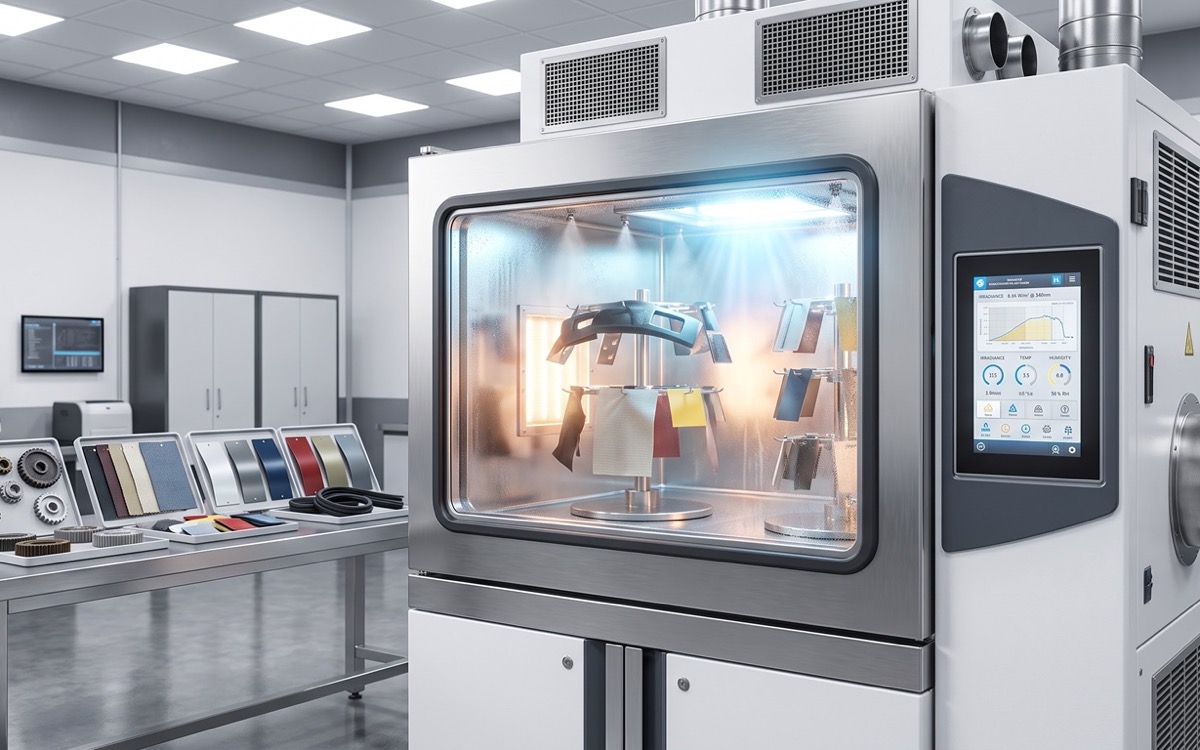
What Is a Xenon Test Chamber and How Does Xenon Arc Weathering Testing Work?
Learn how xenon arc weathering reproduces sunlight, heat and moisture in controlled laboratory conditions to evaluate fading, colour change, ageing and material durability.
SUMMARY: A Xenon Test Chamber is a laboratory weathering instrument that exposes materials to filtered xenon-arc light under controlled temperature, humidity and moisture conditions. Xenon arc weathering is used to evaluate how textiles, plastics, coatings, automotive materials and other products respond to sunlight and environmental ageing without relying only on long-term outdoor exposure.
A Xenon Test Chamber is an accelerated weathering instrument that exposes specimens to filtered xenon-arc radiation while controlling environmental factors such as temperature, humidity and water spray. The objective is to reproduce important effects associated with sunlight and moisture so manufacturers can evaluate material ageing under repeatable laboratory conditions.
Xenon testing is particularly valuable where colour, appearance and broad-spectrum solar exposure matter. It is used for textiles, polymers, automotive materials, paints, coatings, leather, packaging and other products whose performance can change after prolonged exposure to light, heat and moisture.
Apple Electroniks offers both xenon arc and fluorescent UV accelerated weathering systems, allowing laboratories to select the light source according to the applicable material, failure mechanism and test standard. Its xenon range includes the XWT/T tabletop model with an 1800 W air-cooled xenon lamp and the XWT/E system with a 2400 W xenon lamp and advanced programmable exposure controls.
Table of Contents
- What is a Xenon Test Chamber?
- How does xenon arc weathering testing work?
- What parameters are controlled during a xenon test?
- Xenon arc vs UV weathering: what is the difference?
- What materials and industries use xenon testing?
- Which standards apply to xenon arc weathering?
- How should xenon weathering results be interpreted?
- How do you choose the right Xenon Test Chamber?
- Frequently asked questions
What Is a Xenon Test Chamber?
A Xenon Test Chamber is a controlled laboratory apparatus that exposes specimens to optically filtered xenon-arc light, usually together with controlled heat, humidity and moisture. Its purpose is to reproduce selected conditions associated with daylight and weathering so changes in colour, appearance and material properties can be evaluated consistently.
Xenon-arc lamps are useful because they provide broad spectral output extending through ultraviolet, visible and infrared wavelengths. The National Renewable Energy Laboratory, for example, describes xenon-arc equipment within its accelerated exposure facilities as providing UV-visible-to-infrared exposure, distinguishing it from systems designed primarily around the ultraviolet portion of the spectrum.
Optical filters are important because an unfiltered lamp is not automatically equivalent to sunlight. Filter combinations are selected to reproduce conditions such as direct outdoor daylight, daylight passing through window glass, particular material or automotive exposure conditions, or specified ISO, ASTM, AATCC or SAE test protocols.
ISO 4892-2 specifically describes exposing plastics to filtered xenon-arc light in the presence of moisture, with temperature, humidity and wetting controlled according to the intended exposure. The current 2013 edition was reconfirmed by ISO in 2023, with an amendment addressing daylight-filter classification published in 2021.
For laboratories evaluating full-spectrum light exposure, Apple Electroniks' XWT/T Air-Cooled Xenon Arc Tester and XWT/E Air-Cooled Xenon Arc Tester are designed around this xenon-arc approach.
How Does Xenon Arc Weathering Testing Work?
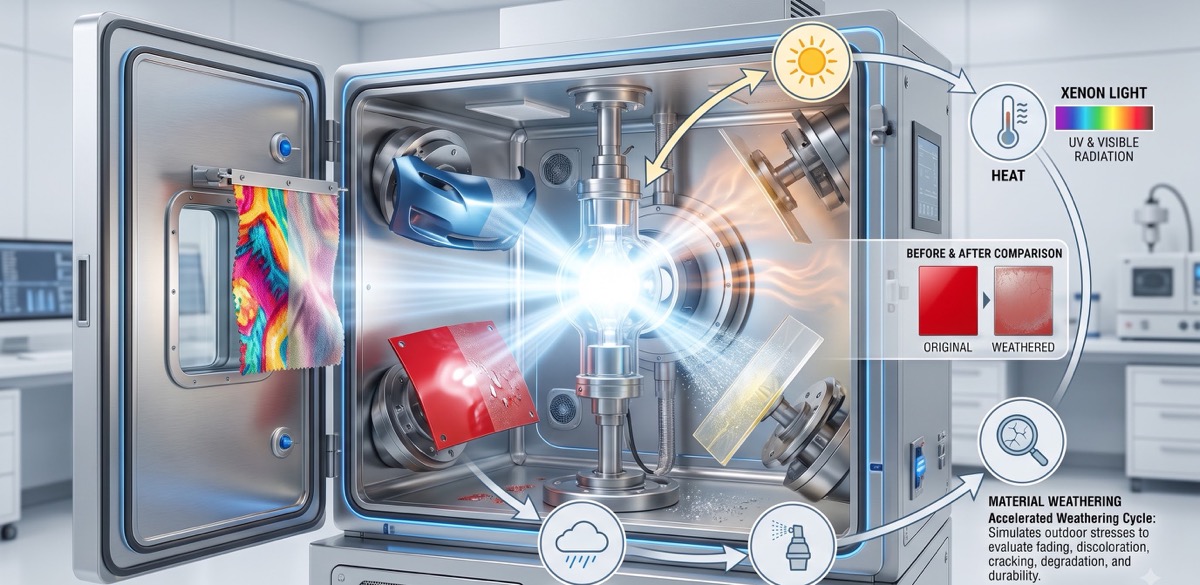
Xenon arc weathering works by placing prepared specimens inside a test chamber and repeatedly exposing them to defined combinations of filtered xenon light, temperature, humidity, darkness and water spray. The laboratory controls these variables so ageing can be compared between materials, formulations, finishes, colours or production batches under reproducible conditions.
A typical testing workflow is: prepare and condition the specimens, cut or mounted according to the applicable material standard; select the required optical filter and standard, since the required spectral distribution depends on whether the test represents outdoor daylight, light through window glass or another specified exposure; set irradiance, which determines the radiant power reaching the specimen at a specified wavelength or wavelength band; set temperature and humidity, since chamber-air temperature, black-panel or black-standard temperature and relative humidity may all influence degradation; program light, dark and moisture cycles, as samples may experience continuous light, alternating light/dark periods and water-spray cycles depending on the test method; run the specified exposure until the required radiant exposure, number of cycles or exposure time is reached; and measure property changes such as colour difference, gloss, cracking, tensile properties or another specified performance characteristic compared with the original specimen or control.
This process is not merely theoretical. A 2019 NIST study investigating engineering thermoplastics evaluated xenon weathering at up to 0.75 W/m²/nm at 340 nm and found that material response depended on variables including spectral wavelength, humidity and material composition.
Apple Electroniks' XWT/T provides four programmable operating modes: light, light with water spray, dark, and dark with water spray. The XWT/E adds up to 100 programs with as many as 200 configurable steps per program for more complex test cycles.
What Parameters Are Controlled During Xenon Arc Testing?
A xenon weathering test controls more than exposure time. The most important parameters are spectral distribution, irradiance, specimen temperature, chamber temperature, humidity, wetting and exposure cycle. Reliable comparisons require these settings to be defined and reported because changing even one parameter can alter the degradation mechanism or rate.
Irradiance. Irradiance measures radiant power reaching the test surface. Depending on the standard and chamber, it may be controlled at a specific wavelength such as 340 nm or 420 nm, or across a wavelength band. For example, Apple Electroniks lists the XWT/E with digitally controlled ranges including 0.3–0.75 W/m² at 340 nm, 0.5–2.01 W/m² at 420 nm, 30–90 W/m² across 300–400 nm, and 320–780 W/m² across 300–800 nm.
Temperature. Material surface temperature can differ substantially from chamber air temperature, especially with dark specimens. Black Panel Temperature (BPT) or Black Standard Temperature (BST) is therefore commonly monitored. The XWT/T, for example, lists a BST control range of 35°C to 100°C ±2°C, while the XWT/E provides a BST measurement range from −55°C to 125°C.
Moisture and humidity. Weathering can involve humidity, condensation, rain or water spray rather than light alone. ASTM G155-25 specifically covers xenon-arc exposure involving sunlight and moisture such as humidity, rain or dew.
Controlling all these variables matters more than simply increasing lamp power. A meaningful weathering test aims to reproduce the relevant degradation mechanisms — not merely make a specimen fail as quickly as possible.
What Is the Difference Between a Xenon Test Chamber and a UV Weathering Chamber?
A Xenon Test Chamber reproduces a broad portion of the solar spectrum and is particularly useful for colour and full-spectrum light exposure, while fluorescent UV equipment concentrates on the ultraviolet region associated with many photochemical degradation mechanisms. The appropriate technology depends on the material, end-use conditions and governing test standard.
| Factor | Xenon Arc Chamber | Fluorescent UV Chamber |
|---|---|---|
| Light source | Xenon arc lamp | Fluorescent UVA or UVB lamp |
| Spectral emphasis | UV, visible and near-infrared | Primarily ultraviolet |
| Common UV references | Controlled at 340 nm, 420 nm or wavelength bands | UVA-340 or UVB-313 |
| Moisture simulation | Humidity and/or water spray | Condensation and/or water spray |
| Strong use cases | Colour fastness, textiles, plastics, coatings, automotive materials | UV degradation, coatings, plastics and accelerated surface weathering |
| Relevant standards | ASTM G155, ISO 4892-2, ISO 105-B02 | ASTM G154, ISO 4892-3 and related methods |
Apple Electroniks' AWT/UV system uses 340 nm UVA or 313 nm UVB fluorescent lamps and provides an irradiance range of 0.2–1.55 W/m². It accommodates 24 specimens measuring 75 × 150 mm, while the compact AWT/Mini uses three 20 W UVA-340 or UVB-313 lamps and holds 18 standard panels.
This difference is why a laboratory should not select a chamber simply by asking which test is "faster." The applicable standard and expected real-world degradation mechanism should determine whether xenon arc or fluorescent UV exposure is appropriate. Explore Apple Electroniks' accelerated weathering tester range, AWT/UV Weathering Tester and AWT/Mini UV Tester for related systems.
What Materials and Industries Use Xenon Arc Weathering Testing?
Xenon arc weathering is used for materials whose colour, surface condition or physical performance can change after exposure to sunlight, temperature and moisture. Common applications include textiles, plastics, paints, coatings, automotive components, leather, rubber, packaging, technical materials and polymer products intended for indoor or outdoor service.
Textiles. Xenon testing is especially established for colour-fastness evaluation. ISO 105-B02:2014 applies to textiles in all forms, including white, bleached and optically brightened textiles, and uses an artificial source representative of natural daylight D65. ISO reconfirmed this edition in 2025. ISO 105-B04:2024 goes further by evaluating textile colour under combined artificial weathering conditions involving xenon light and water.
Plastics and polymers. ISO 4892-2 addresses xenon-arc exposure of plastics, while NIST research has demonstrated how controlled xenon testing can be compared with outdoor degradation for properties such as colour shift and gloss. NIST also found that not every property correlated equally well, reinforcing the importance of test design.
Paints and coatings. ISO 16474-2 specifies xenon-arc exposure methods for paints and varnishes. The standard was reconfirmed as current by ISO in 2026.
Automotive materials. SAE J2527 defines operating procedures for controlled-irradiance xenon-arc exposure of exterior automotive materials. For high-temperature textile and interior applications, ISO 105-B06 specifies five different sets of exposure conditions, including conditions intended to address light and heat experienced inside motor vehicles.
Which Standards Apply to Xenon Test Chambers?
The correct xenon test standard depends on the material and intended application. Major references include ASTM G155 for xenon-arc apparatus operation, ISO 4892-2 for plastics, ISO 105-B02/B04/B06 for textiles, ISO 16474-2 for coatings, AATCC TM16.3 for textile lightfastness and SAE J2527 for automotive exterior materials.
| Standard | Scope | Status |
|---|---|---|
| ASTM G155-25 | Operating practice for xenon arc lamp apparatus used for material exposure | Updated September 2025 |
| ISO 4892-2:2013 | Xenon-arc laboratory exposure of plastics | Confirmed in 2023 |
| ISO 105-B02:2014 | Textile colour fastness to artificial light using a xenon arc fading lamp | Reconfirmed in 2025 |
| ISO 105-B04:2024 | Textile colour fastness to artificial weathering using xenon arc exposure | Current |
| ISO 105-B06:2020 | Colour fastness and ageing under xenon light at elevated temperature | Current |
| ISO 16474-2:2013 | Xenon-arc exposure of paints and varnishes | Confirmed current in 2026 |
| AATCC TM16.3-2020 | Textile colourfastness to xenon-arc light, three principal exposure options | Current |
| SAE J2527 | Controlled-irradiance xenon-arc testing for automotive exterior materials | Current |
The Apple Electroniks XWT/T product page lists standards including ISO 4892-2, ISO 105-B02, ISO 105-B06, ASTM G155 and SAE J2527, while the XWT/E lists ISO, ASTM, AATCC, SAE, JIS and GMW protocols among its supported test references.
Always verify the exact current edition and required exposure cycle before starting a compliance or qualification test.
How Should Xenon Weathering Test Results Be Interpreted?
Xenon weathering results should be interpreted as controlled laboratory exposure data, not as an automatic conversion between chamber hours and years of outdoor service. Correlation with real-world performance depends on material chemistry, spectrum, temperature, moisture, geography, end-use conditions and the property being measured.
This distinction is critical. ASTM G155-25 states that different allowed exposure conditions can produce significantly different results. It also recommends exposing control materials with the test specimens and using at least three replicates of each test specimen and control material to support statistical evaluation.
AATCC makes a similar point for textile lightfastness: its TM16.3 xenon-arc method explicitly states that using the test options does not automatically establish an acceleration relationship with actual end-use exposure.
NIST research provides a practical example. Researchers comparing modified ISO 4892-2 xenon exposure with outdoor weathering in Miami found that colour shift and some gloss behaviour could be predicted effectively, while other effects — particularly those influenced by natural washing from rain or wind — were not reproduced equally well.
Therefore, laboratories should report the test standard and edition, specimen details, optical filter, irradiance, chamber and specimen temperature, relative humidity, spray or wetting cycle, exposure duration or radiant exposure, evaluation method, and control-material results.
The most defensible conclusion is usually comparative: material A performed better or worse than material B under a defined xenon exposure protocol.
How Do You Choose the Right Xenon Test Chamber?
Choose a Xenon Test Chamber by matching the instrument to the required standard, material, spectral range, irradiance control, specimen capacity, temperature and humidity requirements, moisture cycle and data-management needs. Chamber size or lamp wattage alone should never determine selection because test reproducibility depends on controlling the complete exposure environment.
For laboratories requiring a compact xenon system, the Apple Electroniks XWT/T uses an 1800 W air-cooled xenon lamp, provides irradiance control at 340 nm and 420 nm, supports four light/dark/spray modes and lists an estimated lamp service life of 800–1,000 hours.
The more advanced XWT/E uses a 2400 W xenon source, a specimen turntable rotating at 5 RPM, up to 100 stored programs, as many as 200 steps per program, and individual specimen timers. Depending on holder format, it accommodates 12–15 ISO-size specimens or seven AATCC-size specimens.
Before purchasing, ask: which exact ISO, ASTM, AATCC, SAE or customer specification must be performed? Does the standard require xenon arc or fluorescent UV? Which optical filter system is required? Which irradiance wavelength or band must be controlled? Are humidity, condensation or water spray required? What specimen dimensions and chamber capacity are needed? Is automatic irradiance compensation required? What calibration, maintenance and after-sales support is available?
Apple Electroniks provides xenon and UV options within its weathering testing equipment range, allowing laboratories to select equipment according to the applicable material-testing method rather than treating all accelerated weathering technologies as interchangeable.


