


 Opening Hours : Mon to Sat : 10 AM to 6 PM
 Call us :
07313726805
Call us :
07313726805

 Send Inquiry
Wire Elongation Tester
Wire Elongation Tester Specification
- Temperature
- 10C to 40C operating range
- Specimen Size
- 0.5 mm to 5 mm diameter wires
- Number of Specimens
- 1 specimen at a time
- Gas Pressure
- N/A (Test is mechanical)
- Test Material
- Copper, Aluminum, Steel wires
- Humidity
- Up to 80% RH (non-condensing)
- Test Range
- Up to 1000 mm elongation
- Type
- Manual/Automatic
- Material
- Stainless Steel and Mild Steel Construction
- Power
- 230 V AC, 50 Hz
- Power Source
- Electric
- Dimension (L*W*H)
- Approx. 1000 mm x 300 mm x 350 mm
- Weight
- Approx. 60 kg
- Usage
- To test the elongation of wire specimens under tensile force
- Application
- Wire Industry, Cable Manufacturing, Quality Control Labs
- Safety Features
- Overload protection, Emergency stop switch
- Compliance Standards
- IS, ASTM, IEC as applicable
- Optional Features
- Data logging & PC interface
- Elongation Measurement Accuracy
- ±0.5 mm
- Load Application
- Screw-driven or pneumatic
- Calibration
- Supplied with standard calibration certificate
- Finish
- Powder coated
- Display
- Analog or Digital scale for elongation
- Grip Type
- Adjustable clamping jaws
Wire Elongation Tester Trade Information
- Minimum Order Quantity
- 1 Unit
- Payment Terms
- Telegraphic Transfer (T/T), Cash in Advance (CID)
- Supply Ability
- 10 Units, , Per Week
- Delivery Time
- 30 Days
- Main Domestic Market
- All India, North India, Daman and Diu, West Bengal, Madhya Pradesh, Jammu and Kashmir, Uttar Pradesh, Tripura, Haryana, Andaman and Nicobar Islands, Kerala, South India, Jharkhand, Central India, Uttarakhand, Dadra and Nagar Haveli, Himachal Pradesh, Chhattisgarh, Mizoram, Tamil Nadu, Assam, Pondicherry, Manipur, Maharashtra, Odisha, Sikkim, Chandigarh, Meghalaya, Punjab, Goa, Bihar, Delhi, Lakshadweep, , Nagaland, Karnataka, Gujarat, Andhra Pradesh, East India, Rajasthan, Telangana, West India, Arunachal Pradesh
About Wire Elongation Tester
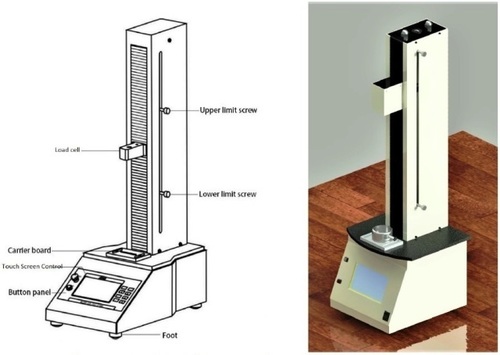
Wire Elongation Tester is unique instrument for wire elongation, with good stability, wide application and convenient usage with function of step less speed adjusting, uniform motion, converting mode between manual and automatic operation. It is used for various applications such as wire crimp force testing, Tensile Testing, Push & Pull Testing, Puncture /Piercing force, Penetration test, Measuring Strength of Glass Ampules as well as Scientific Research Institute & many more.
Features:
- Color Touch Screen Display
- PLC & Servo Drive for precise Operation.
- Simple operation, able to be used with various kinds of fixtures.
- Step less speed regulation, gear drive
- Compact design & structure with stable drive
Specifications:
- Capacity : 500N (50Kg)
- Accuracy : 0.1N / 0.01Kg/ 0.02lb
- Units : N, Kgf, Lbf
- Traveling Length : 500mm (Customized)
- Speed Selector : 0 to 500 mm/min
- Data Output : USB/ Ethernet for data saving & Network printing purpose.
- Power/Air : 220/110 V 50/60 Hz
- Weight : 75 Kg Dimensions : 400 x 400 x 1080mm(L x W x H)
High-Precision Measurement and Compliance
Engineered for reliable results, the Wire Elongation Tester offers precise elongation readings with an accuracy of 0.5 mm. The unit comes with a standard calibration certificate and complies with international testing standards, including IS, ASTM, and IEC. The optional digital display and data logging features allow for thorough documentation and quality assurance.
User-Friendly Operation and Safety
Users can easily test one sample at a time with the adjustable clamping jaws, accommodating a range of wire sizes from 0.5 mm to 5 mm. The tester offers both manual and automatic operations, built-in overload protection, and an emergency stop switch, ensuring a safe testing environment. The powder-coated body enhances durability and ease of maintenance.
Versatile Applications
This tester is ideal for conducting wire elongation tests in environments such as the wire industry, cable manufacturing facilities, and quality control laboratories. With compatibility for copper, aluminum, and steel wires, and a test range up to 1000 mm elongation, it addresses diverse material testing needs within a temperature range of 10C to 40C and up to 80% RH (non-condensing).
FAQs of Wire Elongation Tester:
Q: How is elongation measured with the Wire Elongation Tester?
A: Elongation is measured using either an analog or digital display system, depending on your configuration. The device ensures accurate elongation measurement up to 1000 mm with a precision of 0.5 mm for wire specimens under tensile force.Q: What types of wires and specimen sizes are compatible with the tester?
A: The tester supports copper, aluminum, and steel wires with diameters ranging from 0.5 mm to 5 mm. Its adjustable clamping jaws securely grip the specimen during testing for dependable results.Q: When should the calibration certificate be used or referenced?
A: The calibration certificate, supplied as standard, should be referenced before initial use and at scheduled intervals as part of your laboratorys quality assurance and compliance processes to verify measurement accuracy.Q: Where can the Wire Elongation Tester be used effectively?
A: This equipment is suitable for use in wire industry manufacturing plants, cable production companies, and quality control laboratories that require strict compliance with IS, ASTM, and IEC standards.Q: What is the testing process using this machine?
A: A single wire specimen is mounted between the adjustable jaws. The user applies tensile force via screw-driven or pneumatic mechanisms. The tester then measures the elongation until a pre-defined limit or failure point is reached.Q: How does the tester ensure operator and specimen safety?
A: Safety features include overload protection and an emergency stop switch, providing security for both operators and equipment during high-tension tests.Q: What are the main benefits of using this Wire Elongation Tester?
A: Benefits include highly accurate elongation measurements, robust safety mechanisms, compliance with international standards, user-friendly operation, and optional advanced data logging and PC interface capabilities to enhance quality control and reporting.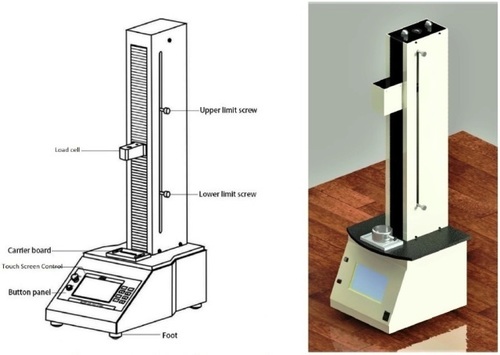

Price:
- 50
- 100
- 200
- 250
- 500
- 1000+

More Products in Universal Testing Machine Category
Automatic Peel Strength Tester
Minimum Order Quantity : 1 Unit
Usage : Testing Adhesion Strength
Material : Mild Steel / Stainless Steel
Type : Other, Automatic Peel Strength Tester
Power Source : Electric
digital peel strength tester
Price 399680 INR / Unit
Minimum Order Quantity : 1 Unit
Usage : Industrial
Material : Mild Steel
Type : digital peel strength tester
Power Source : Electric
Automatic Pull Force Tester With Touch Screen Display
Minimum Order Quantity : 1 Unit
Usage : Measuring pull force of crimped terminals and wires
Material : Mild Steel
Type : Other, Automatic Pull Force Tester
Power Source : Electric

UTM 2.5T E series Universal Testing Machine
Price 1592680 INR / Unit
Minimum Order Quantity : 1 Unit
Usage : Laboratory
Material : Mild Steel
Type : Universal Testing Machine
Power Source : Electric


- B, 314-315, Hub Town, Makarpura Bus Depot, Vadodara - 390010, Gujarat, India
- Phone : 07313726805

- Mr Vinodkumar Gaikwad (CEO)
- Mobile : 07313726805
- Send Inquiry
- A-40, Unnadeep Complex, Tower-A, Susen Tarsali Ring Road, Tarsali, Vadodara - 390010, Gujarat, India
Mr. Vinodkumar (CEO)
Mobile :+919998755997, +919558979952
 Send Inquiry
- Fiber Testing Machine
- Fabric Recovery Testing Machine
- Strength and Fatige Testing Machine
- Color Fastness Testing Machine
- Abrasion and Pilling Testing Machine
- Flammability Testing Machine
- Universal Testing Machine
- Shrinkage Testing Machine
- Sampling Machine
- Dyeing and Finishing Machine
- Geo Textile Non Woven Testing Equipment
- Color Machining Testing Equipment
- Cotton Ginning Machine
- Yarn Testing Machine
- Oil Extraction Apparatus
- Laboratory Air Compressor
- WIRE TESTING MACHINE
- Textile Testing Equipment
- Flammability Tester
- Pull Testers
- Fibers Testing Equipment & Machine
- Texture Analyzer


Developed and Managed by Infocom Network Private Limited.

