


 Opening Hours : Mon to Sat : 10 AM to 6 PM
 Call us :
07313726805
Call us :
07313726805

 Send Inquiry
Schildknecht Flexing Tester
Price 1800000 INR/ Unit
Schildknecht Flexing Tester Specification
- Material
- SS
- Power Source
- Electric
- Dimension (L*W*H)
- 360x490x280 mm(LxWxH) Millimeter (mm)
- Weight
- 45 Kg Kilograms (kg)
- Usage
- Industrial Use
Schildknecht Flexing Tester Trade Information
- Minimum Order Quantity
- 1 Unit
- Supply Ability
- 10 Units Per Week
- Delivery Time
- Week
- Main Domestic Market
- Haryana, Central India, Goa, Tamil Nadu, Arunachal Pradesh, East India, West Bengal, Jharkhand, Dadra and Nagar Haveli, Himachal Pradesh, South India, Jammu and Kashmir, Assam, Andhra Pradesh, Gujarat, Maharashtra, Karnataka, Meghalaya, Mizoram, Sikkim, , North India, Chhattisgarh, Daman and Diu, Nagaland, Chandigarh, Madhya Pradesh, West India, Rajasthan, Andaman and Nicobar Islands, Delhi, Punjab, Lakshadweep, Odisha, Telangana, Tripura, Bihar, Pondicherry, Uttarakhand, Manipur, Uttar Pradesh, Kerala, All India
About Schildknecht Flexing Tester
To examine the coated fabrics' resistance against damages that are caused due to flexing which many times is a result of high oscillation of around 500 times/minute, Schildknecht Flexing Tester are used. The tester can accommodate up to 10 samples of fabrics at once and comes with a resettable electronic counter that can record the number of cycles per minute. It has a pair of stainless steel cylinders, whose axis are aligned in the same line. There is a reciprocating grip for facilitating the flexing and unflexing action with the help of hose clip that comes along with the instrument. For indication and control of the number of test cycles in the machine, a six digit electronic preset counter is present at the top.
Specification :
- Counter: 1-999999 times
- Power : 220 V 50/60 Hz
- Weight : 45 Kg
- Dimensions : 360 x 490 x 280 mm(L x W x H)
Robust Stainless Steel Construction
Crafted from high-grade stainless steel, the Schildknecht Flexing Tester provides exceptional durability and resistance to corrosion, making it suitable for sustained industrial use. Its robust build ensures a long service life and dependable testing performance.
Compact Design for Maximum Efficiency
With dimensions of 360x490x280 mm (LxWxH), this tester fits conveniently in various laboratory settings without occupying excessive space. Its 45 kg weight further enhances its stability while in operation, reducing vibrations and ensuring accurate results.
Electric Power for Reliable Testing
Operating on an electric power source, the Schildknecht Flexing Tester offers consistent performance and ease of operation. This eliminates the need for manual intervention, helping to streamline the testing process and improve productivity.
FAQ's of Schildknecht Flexing Tester:
Q: How is the Schildknecht Flexing Tester used in industrial applications?
A: The Schildknecht Flexing Tester is used in industrial environments to evaluate the flex durability of materials such as textiles, rubber, or synthetic samples. By simulating repeated flexing, it helps determine a material's resistance to wear and fatigue.Q: What materials can be tested with this machine?
A: This tester is suitable for a wide array of flexible materials, including textiles, leather, synthetic fabrics, rubber sheets, and industrial coatings, making it versatile for various quality control and research applications.Q: When should the Schildknecht Flexing Tester be used during the production process?
A: It is typically utilized during the quality assurance phase to ensure that raw materials or finished products meet durability standards before moving forward in the production cycle or distribution.Q: Where is the Schildknecht Flexing Tester manufactured and supplied from?
A: The machine is manufactured, exported, and supplied from India, catering to both domestic and international industrial testing requirements.Q: What is the process for operating the Flexing Tester?
A: Operation involves placing the test specimen in the holder, setting the desired cycle parameters, and initiating the test. The electrically powered unit then flexes the sample in accordance with preset standards, recording the number of cycles completed until failure.Q: What are the benefits of using an electric-powered Flexing Tester?
A: An electric-powered Flexing Tester ensures uniform testing conditions, reduces manual effort, and increases throughput in industrial laboratories. This leads to more accurate, reproducible results and improved workflow efficiency.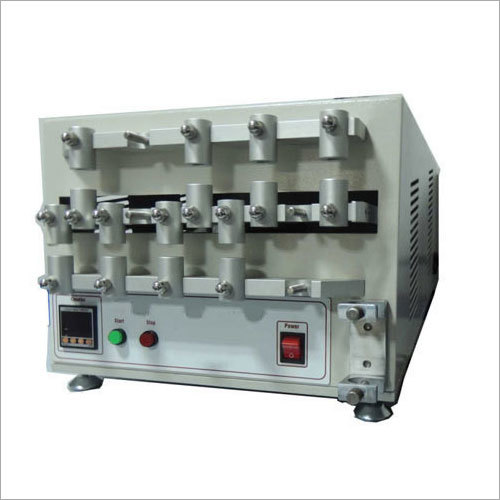

Price:
- 50
- 100
- 200
- 250
- 500
- 1000+

More Products in Fabric Recovery Testing Machine Category
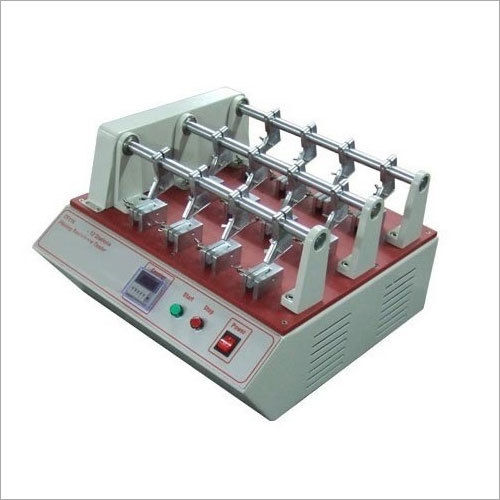
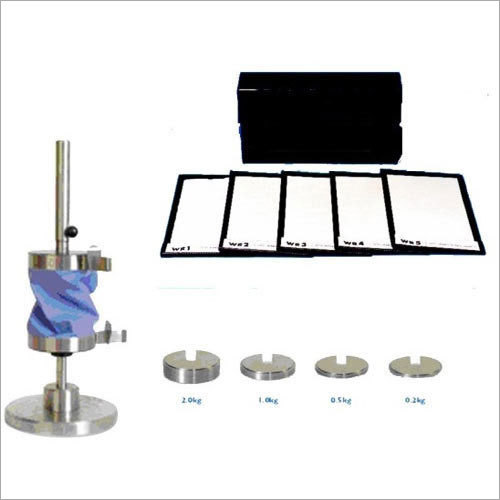
Flexing Resistance Tester
Price 1900000 INR / Unit
Minimum Order Quantity : 1 Unit
Material : SS
Usage : Industrial Use
Dimension (L*W*H) : 480 x 480 x 320 mm(LxWxH) Millimeter (mm)
Type : Other, Flexing Resistance Tester
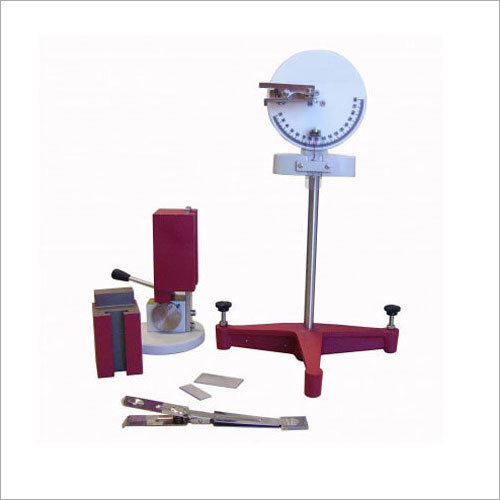
AATCC Wrinkle Recovery Tester
Price 1800000 INR / Unit
Minimum Order Quantity : 1 Unit
Material : Stainless steel, Aluminum alloy
Usage : Industrial Use
Dimension (L*W*H) : 150x150x330 mm(LxWxH) Millimeter (mm)
Type : Other, Wrinkle Recovery Tester
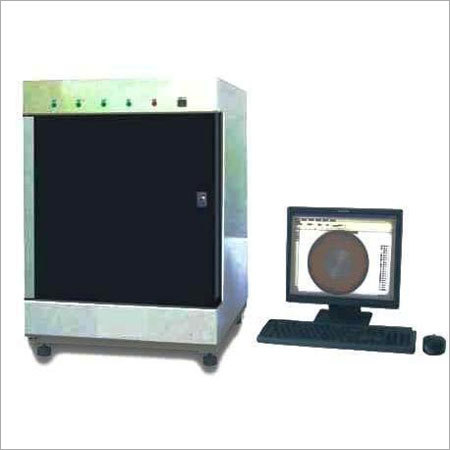
Crease Recovery Tester
Price 1700000 INR / Unit
Minimum Order Quantity : 1 Unit
Material : SS
Usage : Industrial Use
Dimension (L*W*H) : 170x170x360 mm(LxWxH) Millimeter (mm)
Type : Other, Testing Instrument
Fabric Drape Tester
Price 1700000 INR / Unit
Minimum Order Quantity : 1 Unit
Material : SS
Usage : Industrial Use
Dimension (L*W*H) : 480 x 540 x 870mm (LxWxH) Millimeter (mm)
Type : Other, Laboratory Testing Equipment


- B, 314-315, Hub Town, Makarpura Bus Depot, Vadodara - 390010, Gujarat, India
- Phone : 07313726805

- Mr Vinodkumar Gaikwad (CEO)
- Mobile : 07313726805
- Send Inquiry
- A-40, Unnadeep Complex, Tower-A, Susen Tarsali Ring Road, Tarsali, Vadodara - 390010, Gujarat, India
Mr. Vinodkumar (CEO)
Mobile :+919998755997, +919558979952
 Send Inquiry
- Fiber Testing Machine
- Fabric Recovery Testing Machine
- Strength and Fatige Testing Machine
- Color Fastness Testing Machine
- Abrasion and Pilling Testing Machine
- Flammability Testing Machine
- Universal Testing Machine
- Shrinkage Testing Machine
- Sampling Machine
- Dyeing and Finishing Machine
- Geo Textile Non Woven Testing Equipment
- Color Machining Testing Equipment
- Cotton Ginning Machine
- Yarn Testing Machine
- Oil Extraction Apparatus
- Laboratory Air Compressor
- WIRE TESTING MACHINE
- Textile Testing Equipment
- Flammability Tester
- Pull Testers
- Fibers Testing Equipment & Machine
- Texture Analyzer


Developed and Managed by Infocom Network Private Limited.

