
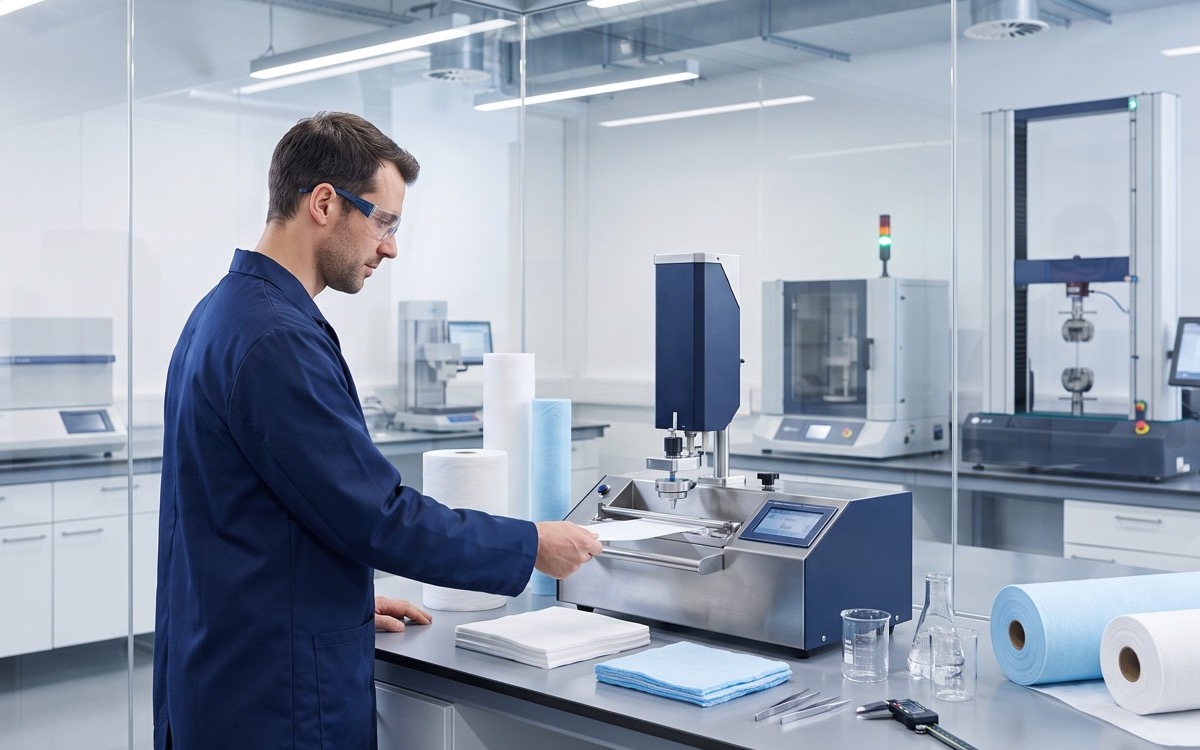
Nonwoven Testing Equipment for Hygiene Products: Complete Quality Control Guide
Learn how to select and use nonwoven testing equipment to control liquid handling, breathability, strength, softness, and batch consistency in hygiene materials.
SUMMARY: Nonwoven testing equipment helps hygiene-product manufacturers verify whether coverstocks, acquisition layers, absorbent materials, and related fabrics perform consistently before conversion or product release. A reliable quality-control program combines liquid strike-through, wetback, air permeability, basis weight, thickness, tensile strength, and product-specific absorbency testing.
Nonwoven testing equipment helps hygiene-material manufacturers measure the properties that directly affect product consistency, including liquid transfer, rewet, air flow, tensile strength, thickness, and surface feel. For diapers, sanitary pads, wipes, medical disposables, and absorbent hygiene materials, reliable testing turns material specifications into repeatable production decisions.
Table of Contents
- What is nonwoven testing equipment?
- Which material properties should hygiene-product manufacturers test?
- How do liquid strike-through and wetback tests measure comfort?
- How do you build a reliable nonwoven quality-control plan?
- How should you choose nonwoven testing equipment?
- Which testing standards and records should laboratories use?
- Frequently asked questions
What is nonwoven testing equipment?
Nonwoven testing equipment is a set of instruments that measures the properties controlling hygiene-material performance: basis weight, thickness, liquid transfer, rewet, air flow, strength, and surface feel. For Apple Electroniks customers, the goal is a repeatable material specification—not a one-off pass result—that supports comfort, conversion efficiency, and consistent batches.
A nonwoven is an engineered fibrous assembly that gains structural integrity through physical or chemical bonding rather than weaving or knitting. This material category includes spunbond, meltblown, spunlace, airlaid, and composite structures used in hygiene, medical, filtration, wipes, and technical textile applications. EDANA’s definition of nonwovens emphasizes engineered fibre assemblies with measurable structural integrity.
For hygiene products, testing should reflect the role of each layer. A skin-contact coverstock must transfer liquid quickly, while an absorbent core must retain it. A breathable backsheet or laminate may require air or water-vapour testing, while elastic or structural components require tensile and elongation analysis.
Apple Electroniks supports nonwoven and hygiene material testing for liquid strike-through, air permeability, softness, tensile strength, elongation, bursting strength, and absorbency-related performance evaluation.
Which material properties should hygiene-product manufacturers test?
A practical hygiene-material test plan measures five connected property groups: construction, liquid management, breathability, mechanical integrity and surface feel. It should select one validated method for each critical quality attribute, then use the same conditioning, sampling and reporting rules for every comparable production lot.
Basis weight is the mass of a material per unit area, normally expressed in g/m². It is a core construction-control value because changes in basis weight can influence thickness, strength, liquid handling, material cost, and product feel. ISO 9073-1:2023 specifies a method for determining mass per unit area of nonwoven fabrics.
Coverstock is the skin-contact outer layer of an absorbent hygiene product, often called a topsheet. Its main function is to allow fluid to move inward while helping the surface remain comparatively dry.
| Quality-control area | What to measure | Typical result | Relevant method or reference | Suitable Apple Electroniks equipment |
|---|---|---|---|---|
| Construction | Basis weight and thickness | g/m², mm | ISO 9073-1:2023; ISO 9073-2 | Precision balance, thickness measurement setup |
| Liquid management | Liquid strike-through time | Seconds | ISO 9073-8:2025 | LSW/S Liquid Strike Through Time & Wetback Tester |
| Liquid management | Rewet performance | Wetback after liquid exposure | ISO 9073-14:2023 | LSW/S Liquid Strike Through Time & Wetback Tester |
| Breathability | Air permeability | mm/s, L/m²/s, cfm | ISO 9073-15:2007; WSP 70.1 | APT/E Auto Air Permeability Tester |
| Mechanical integrity | Tensile strength and elongation | N, %, force-extension curve | ISO 9073-3:2023 | UTM 5K Universal Testing Machine |
| Surface feel | Softness and surface response | Product-specific comparison value | Customer or internal method | Leather Softness Tester / selected fixture |
| Product absorbency | Acquisition, retention, rewet | Product-specific values | Applicable ISO, NWSP, customer method | Configured hygiene-material test setup |
SO identifies ISO 9073-3:2023 for tensile strength and elongation using the strip method, while ISO 9073-15:2007 covers air flow passing perpendicularly through nonwoven materials.
How do liquid strike-through and wetback tests measure comfort?
Liquid strike-through and wetback tests measure different parts of liquid comfort: how quickly liquid passes through a coverstock and how much returns toward the surface after pressure. Use both when the skin-contact layer must move liquid inward quickly while remaining comparatively dry after an absorption event.
Liquid strike-through time is the time required for a known amount of test liquid to pass through a nonwoven coverstock into the underlying absorbent medium. Lower time can indicate faster liquid transfer, but the target result should always be set against the product design and approved control limits.
Wetback, also called rewet, is the amount of absorbed liquid that returns toward the product surface when pressure is applied. In feminine hygiene testing guidance, EDANA describes wetback as a measurement of liquid released back toward skin after absorption and pressure.
ISO 9073-8:2025 is the current ISO method for liquid strike-through time in nonwoven coverstocks. It replaced ISO 9073-8:1995, which ISO now lists as withdrawn. ISO 9073-14:2023 covers coverstock wetback using simulated urine.
Apple Electroniks’ LSW/S Liquid Strike Through Time & Wetback Tester is designed for both liquid strike-through and wetback testing. Its published configuration includes a 125 × 125 mm specimen size, 0.01-second timer accuracy, approximately 25 ml liquid flow in 3.5 ± 0.25 seconds, and a simulated 4,000 ± 20 g baby weight.
Important: liquid strike-through is a material-performance method. It does not independently simulate every real-world condition of a finished diaper, sanitary pad, wipe, or medical hygiene product. Use it with wetback, absorption, fit, leakage, and finished-product validation methods where relevant.
How do you build a reliable nonwoven quality-control plan?
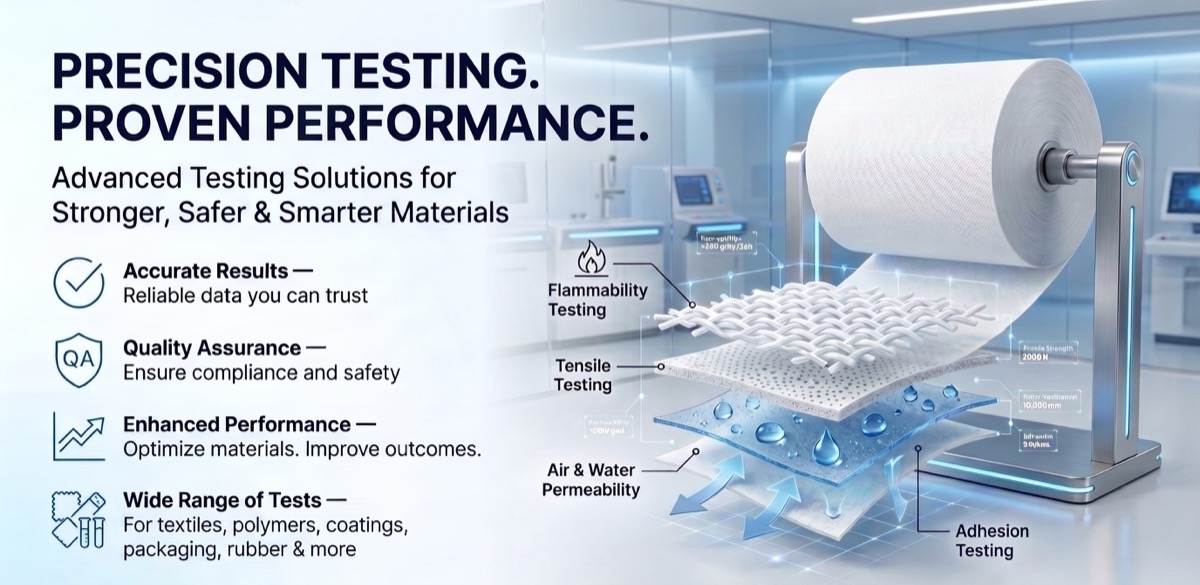
A reliable nonwoven QC plan defines the critical attributes before production, samples material in a controlled way, tests against approved limits, records the result, and applies a documented response to failures. The plan must distinguish continuous measurement results from visual or attribute-based acceptance checks.
Use this six-step quality-control process:
Define critical quality attributes. Identify the values that matter for each product layer, such as basis weight, strike-through time, wetback, air permeability, tensile strength, elongation, softness, or absorbency.
Set approved limits before routine production. Create internal target, warning, and rejection limits using product-development trials, customer specifications, contract requirements, and validated production history.
Condition samples consistently. ISO 139:2005 defines standard atmospheres for conditioning and testing textile materials. Record the agreed conditioning environment in the test method and report.
Sample across the production roll or lot. Collect samples from the beginning, middle, and end of production where appropriate. For directional materials, compare machine direction and cross direction when the product specification requires it.
Test, compare and disposition. Compare results with approved limits. Hold, investigate, rework, or release the lot according to the documented quality procedure.
Trend results over time. Monitor recurring movement in strike-through, basis weight, tensile strength, or air permeability before the result becomes an out-of-specification failure.
For attribute-based lot inspection, ISO 2859-1:2026 provides acceptance-sampling schemes indexed by Acceptance Quality Limit (AQL). AQL should not replace performance limits for numerical material-test results; it is a sampling framework for acceptance decisions.
How should you choose nonwoven testing equipment?
Choose nonwoven testing equipment by starting with the required method, material range and reporting needs—not the machine name alone. The best setup reproduces the customer-specified test conditions, accommodates actual specimens and fixtures, controls operator variation, and preserves traceable data for release, audits and improvement.
Before selecting equipment, confirm these six points:
Required standard and edition: Verify whether the customer calls for ISO, NWSP, ASTM, EDANA, BIS, or an internal method.
Test range: Ensure the instrument covers the material’s expected permeability, load range, thickness, or liquid-transfer performance.
Fixture compatibility: Confirm specimen dimensions, clamp type, test head area, weights, absorbent pads, and accessories.
Automation level: Automatic timing, dosing, clamping, and reporting can reduce operator-to-operator variation.
Data handling: Prioritize equipment that supports operator records, lot numbers, result storage, report export, and calibration documentation.
Service support: Choose a supplier that can support installation, training, calibration planning, and method-specific accessories.
For example, Apple Electroniks’ APT/E Auto Air Permeability Tester lists a measuring range of 0.2 to 12,000 mm/s, eight automatically positioned aperture sizes, and measurement accuracy of up to ±2%.
For strength testing, the Apple Electroniks UTM 5K Universal Testing Machine lists selectable load-cell capacities from 120 N to 10,000 N, ±0.5% indicated-load accuracy, and 0.01 mm displacement resolution. These details should be matched to the approved nonwoven method and expected material strength range.
Which testing standards and records should laboratories use?
Testing standards make results comparable only when the laboratory follows the correct edition, conditioning instructions, fixtures and calculation rules. In 2026, laboratories should verify every cited ISO or NWSP revision against their product specification, because a method number can remain familiar while a newer edition change technical requirements.
A core standards map for nonwoven and hygiene testing may include:
ISO 9073-1:2023: Mass per unit area of nonwoven fabrics.
ISO 9073-3:2023: Tensile strength and elongation at break.
ISO 9073-8:2025: Liquid strike-through time for nonwoven coverstocks.
ISO 9073-14:2023: Coverstock wetback.
ISO 9073-15:2007: Air permeability of nonwoven materials.
ISO/IEC 17025:2017: Competence, impartiality, and consistent operation of testing laboratories.
EDANA’s Harmonized Nonwovens Standard Procedures also list specific methods for air permeability, coverstock liquid strike-through, repeated liquid strike-through, wetback, adult incontinence acquisition, and centrifugal liquid retention capacity.
Each final laboratory report should record the product code, lot number, test method and revision, conditioning details, instrument ID, operator, sample quantity, raw result, acceptance limit, and final disposition. ISO/IEC 17025:2017 focuses on reliable laboratory competence and consistent testing operations.
Frequently Asked Questions
These answers address the equipment, methods and controls most often considered by nonwoven and hygiene-product manufacturers. They are concise enough for FAQPage schema, but they should be read with the customer specification, applicable market requirements and the current licensed test method.


