
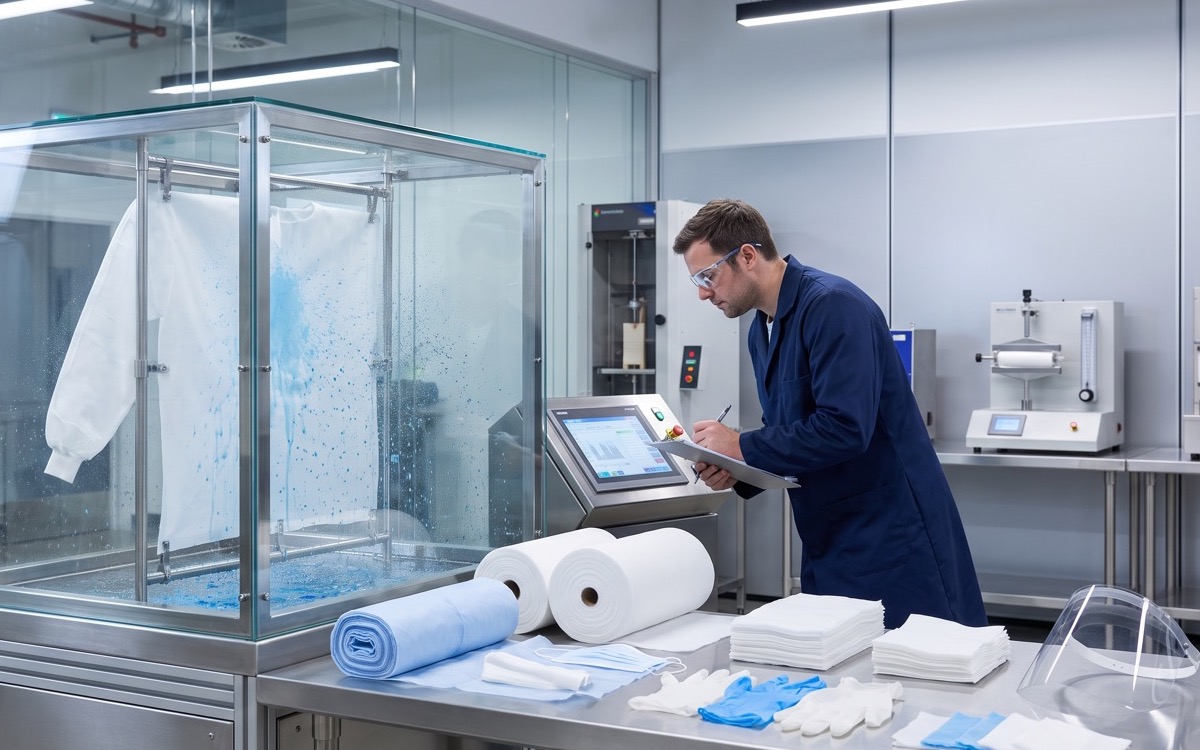
Medical Textile Testing Equipment: PPE Safety and Performance Tests
SUMMARY: Medical textile testing equipment helps manufacturers verify whether PPE materials and finished products meet defined safety, performance, and quality requirements for their intended use. A complete program combines liquid-barrier testing, mask and respirator performance testing, physical-strength testing, airflow measurement, seam evaluation, and documented quality control based on the applicable standard and market claim.
Table of Contents
- What testing does medical PPE need before release?
- Which barrier tests are required for surgical gowns and isolation gowns?
- How should medical face masks and respirators be tested?
- Which mechanical and comfort tests matter for nonwoven medical textiles?
- How do you select medical textile testing equipment?
- What QA workflow makes PPE test results reliable and traceable?
- How can Apple Electroniks build a medical-textile content cluster?
- Frequently asked questions
What testing does medical PPE need before release?
Medical PPE needs a test plan matched to its intended use, product claim, exposure risk, and target-market requirements. Medical textile testing equipment should verify liquid-barrier performance, filtration, breathability, mechanical integrity, seam strength, and finished-product construction where those factors affect protection. A material pass result alone should not be treated as proof that an entire gown, mask, or garment is protective.
Medical textile testing equipment is a group of laboratory instruments used to measure the safety and performance characteristics of healthcare textiles, nonwovens, masks, gowns, drapes, coveralls, and related PPE materials.
A complete testing program usually has two levels:
Material testing: Evaluates fabric, nonwoven, laminate, film, or filter media.
Finished-product testing: Evaluates seams, critical zones, interfaces, fit-related features, and complete garment construction.
The correct requirements vary by product. A surgical isolation gown may require liquid-barrier and seam testing, while a medical face mask requires filtration, differential pressure, synthetic-blood resistance, and flammability evaluation. Respirators such as N95 filtering facepieces follow a separate certification pathway and cannot be evaluated solely as medical face masks.
| Product type | Primary performance focus | Common test standards or methods | Typical equipment needed |
|---|---|---|---|
| Surgical and isolation gowns | Liquid-barrier performance and seam protection | ANSI/AAMI PB70, AATCC 42, AATCC 127, ASTM F1670, ASTM F1671 | Impact penetration tester, hydrostatic head tester, viral penetration test setup |
| Medical face masks | Filtration, breathability, fluid resistance | ASTM F2100, ASTM F2101, ASTM F2299, ASTM F1862 | BFE/PFE tester, differential pressure tester, synthetic blood penetration tester |
| N95 respirators | Filtration, breathing resistance, fit | NIOSH 42 CFR Part 84 | Aerosol filtration system, airflow-resistance system, fit-testing equipment |
| Medical nonwovens | Airflow, tensile strength, tear resistance, liquid handling | ISO 9237, ISO 9073-3, ISO 9073-4 | Air permeability tester, tensile tester, tear tester |
The objective is not to purchase every instrument at once. The objective is to build a test matrix that proves the specific product claim being made.
Which barrier tests are required for surgical gowns and isolation gowns?
Barrier testing for gowns is based on how effectively a material resists water, synthetic blood, body fluids, and microbial penetration under defined test conditions. ANSI/AAMI PB70 classifies healthcare protective apparel into four levels, with Level 1 representing the lowest liquid-barrier protection and Level 4 representing the highest.
Liquid barrier performance is the ability of a textile, nonwoven, laminate, seam, or garment zone to resist penetration by liquids under specified exposure conditions.
For U.S.-referenced ANSI/AAMI PB70 classifications, the main tests include:
Level 1: AATCC 42 impact penetration result of no more than 4.5 g of water.
Level 2: AATCC 42 impact penetration result of no more than 1.0 g, plus hydrostatic pressure resistance of at least 20 cm.
Level 3: AATCC 42 impact penetration result of no more than 1.0 g, plus hydrostatic pressure resistance of at least 50 cm.
Level 4: ASTM F1670 and ASTM F1671 testing, with no penetration at 2 psi or 13.8 kPa under the defined challenge conditions.
ASTM F1671 is especially important where viral penetration resistance is claimed. It uses Phi-X174 bacteriophage as a surrogate microbe and supplements visual inspection with a biological assay capable of detecting viral penetration. ASTM notes that F1670 synthetic-blood testing can be used as an initial screening method, but materials that pass F1670 should be further tested through F1671 when viral-resistance performance must be verified.
Testing should include critical areas, not only a flat fabric swatch. FDA guidance states that surgical isolation gowns must provide the highest rated barrier protection across all critical zones, including seams, except for specified components such as cuffs, hems, and bindings.
This matters because water resistance does not automatically prove blood-borne pathogen resistance. CDC guidance specifically notes that water-based Level 1–3 tests cannot be directly correlated with Level 4 viral-penetration protection.
How should medical face masks and respirators be tested?
Medical face masks and respirators must be tested through different performance pathways because their intended functions are different. ASTM F2100 evaluates medical face-mask materials, while N95 respirators are evaluated through NIOSH certification requirements that include more demanding filtration and breathing-resistance conditions. A face-mask test result should never be used to claim respirator-level protection.
Bacterial filtration efficiency (BFE) is the percentage of bacterial aerosol particles blocked by a mask material under a specified test procedure.
ASTM F2100 identifies five key medical face-mask material performance areas:
Bacterial filtration efficiency
Differential pressure
Sub-micron particulate filtration efficiency
Synthetic-blood penetration resistance
Flammability
Differential pressure is the resistance to airflow through a mask material. It is a material-level breathability indicator, not a complete assessment of user comfort or respirator fit.
For BFE testing, ASTM F2101 uses Staphylococcus aureus attached to liquid droplets ranging from approximately 0.65 to 9 microns, with a mean particle size of about 3 microns.
N95 testing is more demanding and follows NIOSH requirements. NIOSH certification testing uses an aerosol with particles around 0.3 µm, an airflow rate of 85 L/min, and preconditioning at 85% relative humidity and 38°C for 24 hours. N95-class filters must maintain at least 95% collection efficiency during certification testing.
N95 respirator performance also depends on face seal. CDC notes that overall respiratory protection depends on both filter performance and minimizing leakage between the face and the respirator.
Which mechanical and comfort tests matter for nonwoven medical textiles?
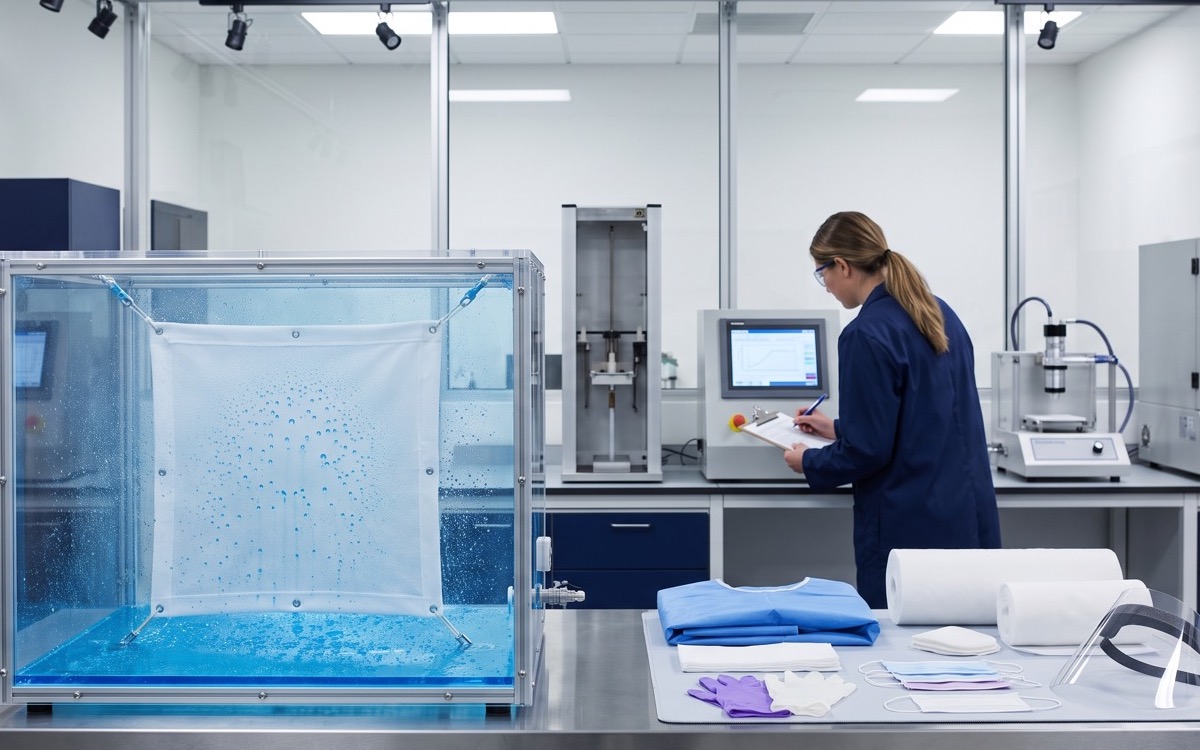
Nonwoven medical textiles need mechanical and comfort testing in addition to barrier testing because a material can resist fluids yet still tear, stretch excessively, lose integrity at seams, shed particles, or restrict airflow during use. The correct method depends on whether the product is a spunbond-meltblown-spunbond material, laminate, woven textile, film composite, or finished sewn assembly.
Air permeability is the rate at which air passes through a textile under specified test conditions. It is commonly used to compare the airflow characteristics of fabrics, technical textiles, and permeable nonwovens.
ISO 9237 describes a method for measuring air permeability and applies to industrial fabrics, technical textiles, nonwovens, and made-up permeable textile articles. The standard was reviewed and confirmed by ISO in 2023, showing that it remains current for air-permeability evaluation.
For nonwoven strength evaluation, ISO 9073-3 measures breaking force and elongation using strip specimens in conditioned or wet conditions. The standard includes two specimen-width options: 25 mm and 50 mm.
Important mechanical tests may include:
Tensile strength and elongation
Tear resistance
Bursting or puncture resistance
Seam tensile strength
Abrasion resistance
Dimensional stability
Wet-strength performance
ISO 9073-4 provides a trapezoid method for determining tear resistance in nonwovens. For sewn articles, ISO 13935 methods evaluate seam maximum force when force is applied perpendicular to the seam.
Apple Electroniks can position air permeability, tensile strength, bursting strength, abrasion resistance, liquid strike-through, and seam-related testing as complementary quality-control tools rather than interchangeable proof of one PPE claim.
How do you select medical textile testing equipment?
The right medical textile testing equipment is selected by starting with the product claim, applicable standard, risk level, and required report format. A basic in-house laboratory can support routine incoming-material and production checks, while viral penetration, respiratory certification, and specialized microbiological tests may require controlled facilities, trained specialists, or accredited external laboratories.
Use this five-step selection process:
Define the exact product. Identify whether the product is a gown, mask, respirator, surgical drape, protective coverall, hygiene nonwoven, or medical textile component.
List the intended claim. Examples include liquid resistance, viral penetration resistance, air permeability, filtration efficiency, tear resistance, or seam strength.
Match the claim with the correct standard. Do not use a water-resistance test to support a viral-barrier claim. Do not use medical face-mask data to support an N95 respirator claim.
Separate routine QA from validation testing. Tensile, air permeability, hydrostatic pressure, and liquid strike-through testing may be suited for frequent internal quality checks. ASTM F1671 involves microbiological testing and ASTM states that it may not be practical as a routine production quality-control method because of the time required.
Specify reporting and calibration requirements. Your test plan should define specimen conditioning, test speed, pressure, sample preparation, acceptance criteria, calibration frequency, and traceable report requirements.
For many medical-textile manufacturers, a practical equipment foundation includes a tensile testing machine, air permeability tester, hydrostatic head tester, impact penetration system, bursting-strength tester, abrasion tester, and suitable fixtures for seams or finished-product samples.
What QA workflow makes PPE test results reliable and traceable?
Reliable PPE testing depends on a controlled quality workflow that covers sampling, conditioning, method setup, test execution, review, acceptance decisions, and traceable documentation. Instruments provide measurements, but the quality system determines whether those measurements are repeatable, meaningful, and linked to the correct production lot or finished product.
A practical workflow includes:
Approve the specification: Define the product type, test method, performance threshold, and target standard edition.
Create a sampling plan: Identify how samples are selected from incoming material, production lots, and finished products.
Condition specimens correctly: Follow the applicable standard for conditioning, wet-state testing, or environmental exposure.
Run calibrated equipment: Record equipment identification, calibration status, operator, method version, and test settings.
Review results against acceptance criteria: Treat failed results as a quality event requiring investigation, retest rules, and documented disposition.
Maintain traceability: Link every report to the material batch, production date, supplier lot, product version, and customer specification.
Testing should include both fabric areas and critical interfaces. ASTM F1671 recognizes that protective clothing specimens can include seams and discontinuous regions, while FDA guidance emphasizes that seam protection should match the rated barrier performance of the gown.
How can Apple Electroniks build a medical-textile content cluster?
This approach helps Apple Electroniks present its testing systems as part of a complete quality-control process not simply individual laboratory instruments.
Frequently asked questions
Medical textile testing equipment questions usually focus on selecting the right method for a product claim rather than choosing a machine first. The correct decision depends on intended use, market requirements, material construction, finished-product design, and the applicable standard edition. Material performance should not be overstated as complete PPE performance.


