


 Opening Hours : Mon to Sat : 10 AM to 6 PM
 हमें कॉल करें :
07313726805
हमें कॉल करें :
07313726805

 जांच भेजें
Price 492680 आईएनआर/ Unit
MOQ : 1 Unit
Specification
- टेस्ट रेंज
- 0 – 1000 gf (Typical, varies by model)
- नमूना आकार
- 63 mm × 50 mm (Typical)
- परीक्षण सामग्री
- Paper, Film, Textile and similar materials
- नमी
- Up to 85% RH (Non-Condensing)
- तापमान
- 10°C to 40°C (Operating Range)
- नमूनों की संख्या
- Single Specimen per Test
- मटेरियल
- Stainless Steel
- पावर सोर्स
- Electric
- उपयोग
- Industrial
- एप्लीकेशन
- Industrial
- Included Accessories
- Weights, Calibration Foil, Sample Clamps
- Pendulum Capacity
- 1600, 3200, 6400 gf (Model-dependent)
- Resolution
- 1 gf
- Tear Angle
- 27.5° (Standard)
- Display Type
- Analog / Digital (as per model)
- Mounting Type
- Table Top
- Finish
- Powder Coated / Polished
- Operating Principle
- Pendulum-Energy Method
- Cut Length for Specimen
- 43 mm (Typical)
- Calibration
- Manual / Automatic (as per model)
Trade Information
- Minimum Order Quantity
- 1 Unit
- आपूर्ति की क्षमता
- प्रति महीने
- डिलीवरी का समय
- दिन
About
| Usage/Application | Industrial |
| Type Of Testing Machines | Eddy Current Dynamometer |
| Packaging Type | Box |
| Display Type | Analog |
| Material | Stainless Steel |
| Color | Blue |
| Country of Origin | Made in India |
High Precision Industrial Testing
Engineered specifically for industrial laboratories and quality control environments, the Elmendorf Tear Strength Tester guarantees accurate and reproducible tear strength evaluations. With a finely calibrated resolution of 1 gf and a selectable display type (analog or digital), it offers tailored functionality suitable for various testing standards and applications. The table-top design and robust stainless steel build provide long-lasting durability and reliable measurements.
Versatile and User-Friendly Operation
This tear tester accommodates single specimen testing and is compatible with materials such as paper, film, and textile. Supplied with various pendulum weights and calibration accessories, it is easy to adapt for different test requirements. The instrument supports both manual and automatic calibration (depending on the model), ensuring accuracy and simplifying routine use. Its straightforward operating procedure streamlines the testing process for maximum efficiency.
Comprehensive Support and Accessories
Each tester is delivered with a complete set of essential tools, including sample clamps, calibration foils, and additional weights for versatile testing capabilities. The comprehensive accessorization encourages correct specimen preparation and efficient calibration. Designed and produced by a leading manufacturer and exporter in India, the Elmendorf Tear Strength Tester is backed by robust after-sales service and expert technical support.
FAQ's of Elmendorf Tear Strength Tester:
Q: How does the Elmendorf Tear Strength Tester operate?
A: The tester operates on the pendulum-energy method, where a specimen is clamped and a pre-determined force is applied using a pendulum. The energy required to tear the sample is measured, providing an accurate indication of the material's tear strength.Q: What types of materials can be tested with this device?
A: This instrument is suitable for testing paper, film, textiles, and similar sheet materials. It accommodates specimen sizes of approximately 63 mm 50 mm, making it ideal for various industrial applications.Q: When should calibration be performed on the tester?
A: Calibration should be carried out periodically to maintain accuracy. Depending on the model, you may perform calibration manually or automatically, and the provided calibration foil and weights simplify this process.Q: Where is this tear strength tester typically used?
A: The Elmendorf Tear Strength Tester is commonly used in industrial settings, quality control laboratories, manufacturing units, and research institutes, particularly in the paper, packaging, textile, and film industries.Q: What is the process for conducting a tear strength test?
A: Begin by cutting the specimen to the specified size (typically 63 mm 50 mm) and mounting it in the sample clamps. Make a 43 mm cut, then release the pendulum to initiate tearing. The device measures the force required, displaying results either digitally or via an analog scale.Q: How do the different pendulum capacities benefit users?
A: Multiple pendulum capacities (1600, 3200, 6400 gf) allow users to select the most suitable range for their material type and expected tear strength, increasing the instrument's versatility and accuracy for diverse sample types.Q: What are the advantages of using a stainless steel, powder-coated finish?
A: Stainless steel construction with powder-coated or polished finishes enhances the instrument's resilience against corrosion and wear, ensuring longevity and consistent performance in industrial environments.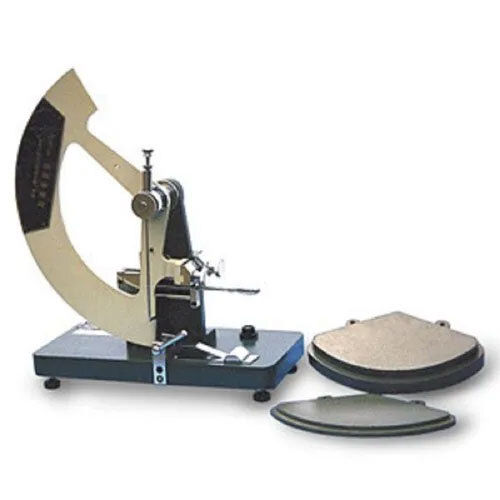
Tell us about your requirement

Price: Â
Quantity
Select Unit
- 50
- 100
- 200
- 250
- 500
- 1000+
Additional detail
मोबाइल number
Email

अधिक Products in Textile Testing Equipment Category

संपर्क करें

- फ़ोन : 07313726805

- Mr Vinodkumar Gaikwad (CEO)
- मोबाइल : 07313726805
- जांच भेजें
- A-40, Unnadeep Complex, Tower-A, Susen Tarsali Ring Road, Tarsali, Vadodara - 390010, Gujarat, India
Mr. Vinodkumar (CEO)
मोबाइल :+919998755997, +919558979952
 जांच भेजें
हमारे उत्पाद
- Textile Testing Equipment
- Textile Testing Equipment
- Textile Testing Equipment
- Textile Testing Equipment
- Textile Testing Equipment
- Textile Testing Equipment
- Textile Testing Equipment
- Textile Testing Equipment
- Textile Testing Equipment
- Textile Testing Equipment
- Textile Testing Equipment
- Textile Testing Equipment
- Textile Testing Equipment
- Textile Testing Equipment
- Textile Testing Equipment
- Textile Testing Equipment
- Textile Testing Equipment
- Textile Testing Equipment
- Textile Testing Equipment
- Textile Testing Equipment
- Textile Testing Equipment
- Textile Testing Equipment


APPLE ELECTRONIKS
सर्वाधिकार सुरक्षित.(उपयोग की शर्तें)
इन्फोकॉम नेटवर्क प्राइवेट लिमिटेड . द्वारा विकसित एवं प्रबंधित
इन्फोकॉम नेटवर्क प्राइवेट लिमिटेड . द्वारा विकसित एवं प्रबंधित

