
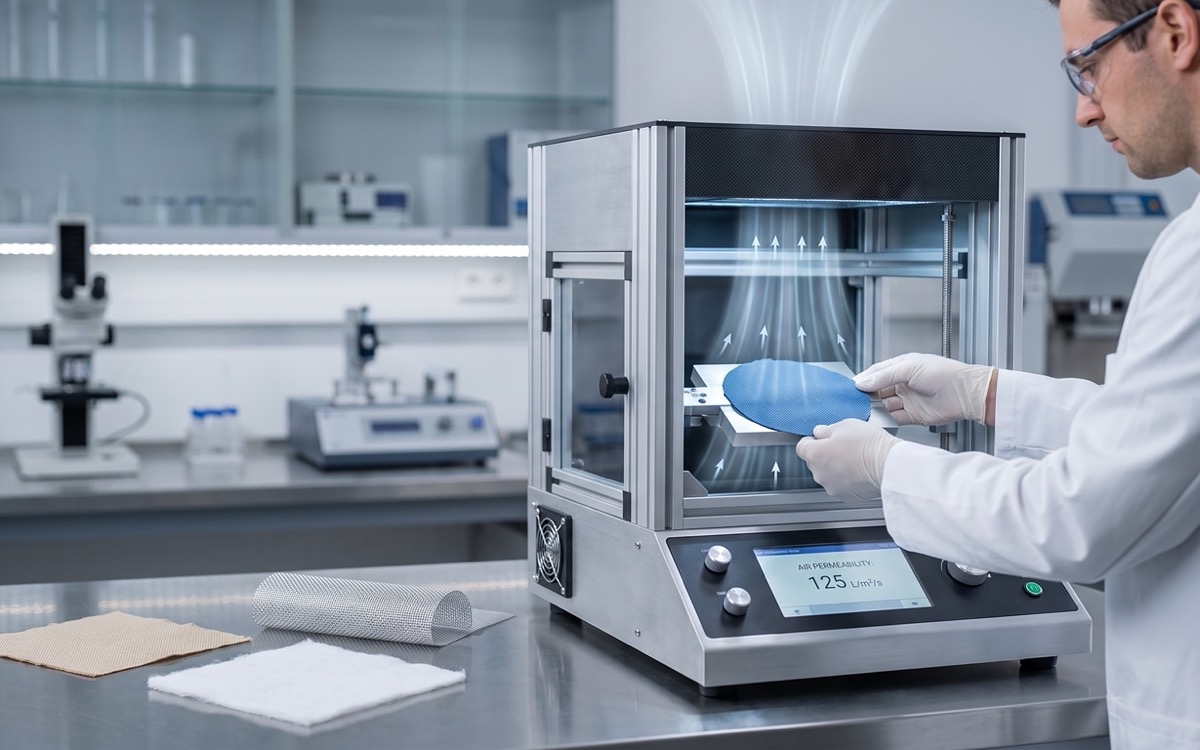
Air Permeability Tester: Complete Guide to Testing Fabrics, Nonwovens & Technical Textiles
Learn how air permeability testing works, which standards apply, how results are measured, and how to select the right tester for fabrics, nonwovens and technical textiles.
SUMMARY: An Air Permeability Tester measures how readily air passes through a defined area of a material under a specified pressure difference. It is widely used to evaluate woven and knitted fabrics, nonwovens, coated materials and technical textiles for breathability, porosity, filtration behaviour and quality consistency under standards such as ASTM D737 and ISO 9237.
An Air Permeability Tester is a laboratory instrument that measures the rate at which air passes through a defined area of a material at a controlled pressure difference. The measurement helps manufacturers evaluate breathability, porosity, filtration behaviour and consistency in fabrics, nonwovens and technical textiles.
Air permeability testing applies to far more than ordinary apparel. ASTM D737 covers woven, nonwoven, knitted, layered, pile, napped and airbag fabrics, including materials that are coated, resin-treated or heavily sized.
For textile laboratories, manufacturers, R&D departments and quality-control teams, understanding the test method is essential because airflow, test area, pressure difference, material construction and conditioning can all affect the reported result.
Table of Contents
- What is an Air Permeability Tester?
- Why is air permeability testing important?
- How does an Air Permeability Tester work?
- Which materials can be tested?
- Which standards apply to air permeability testing?
- How is an air permeability test performed?
- How should results be interpreted?
- What factors affect air permeability?
- ASTM D737 vs ISO 9237 vs ISO 9073-15
- Automatic vs Gurley air permeability testing
- How do you choose the right Air Permeability Tester?
- Common testing mistakes
- Air permeability testing as part of quality control
- Frequently asked questions
What Is an Air Permeability Tester?
An Air Permeability Tester is an instrument used to determine the rate of airflow passing perpendicularly through a known area of material under a specified pressure difference. The result provides a quantitative indication of how easily air can move through the specimen and can be used for product development, specification testing and production quality control.
The fundamental measurement is based on three controlled elements: a defined test area, a specified pressure difference across the specimen, and the resulting airflow through the material.
ISO 9073-15, for example, defines a method for measuring air flowing perpendicularly through a given area of nonwoven material. The standard applies to most nonwovens, including treated and untreated laminates with either low or high basis weight.
Air permeability should not be confused with water permeability or water-vapour transmission. These properties describe different transport mechanisms and therefore require different test methods.
For laboratories handling multiple permeability requirements, Apple Electroniks Air & Water Permeability Testing Equipment covers instruments intended for textiles, nonwovens, paper, packaging, films, membranes and technical fabrics.
Why Is Air Permeability Testing Important for Textiles?
Air permeability testing provides an objective way to determine whether a textile allows the intended amount of air to pass through it. The property can influence thermal comfort, ventilation, filtration, wind resistance and functional performance, making it useful for both product engineering and routine production quality control.
Consider two very different applications. A lightweight sports fabric may be engineered to permit substantial airflow for wearer comfort. A dense filter medium, coated fabric or protective textile may intentionally restrict airflow. Neither a high nor a low reading is automatically "better." The correct value depends on the intended product specification.
Testing is therefore useful for comparing fabric constructions, checking production batches, evaluating finishing or coating processes, comparing suppliers, developing breathable products, assessing filtration materials, verifying technical specifications, and investigating product failures.
ASTM D737 is particularly broad in scope. Its current D737-18(2023) edition applies to most fabrics, including woven fabrics, nonwovens, airbags, blankets, knitted fabrics, layered fabrics and pile fabrics. That breadth makes air permeability an important physical-property measurement across apparel, automotive textiles, filtration, hygiene materials and other engineered textile applications.
How Does an Air Permeability Tester Work?
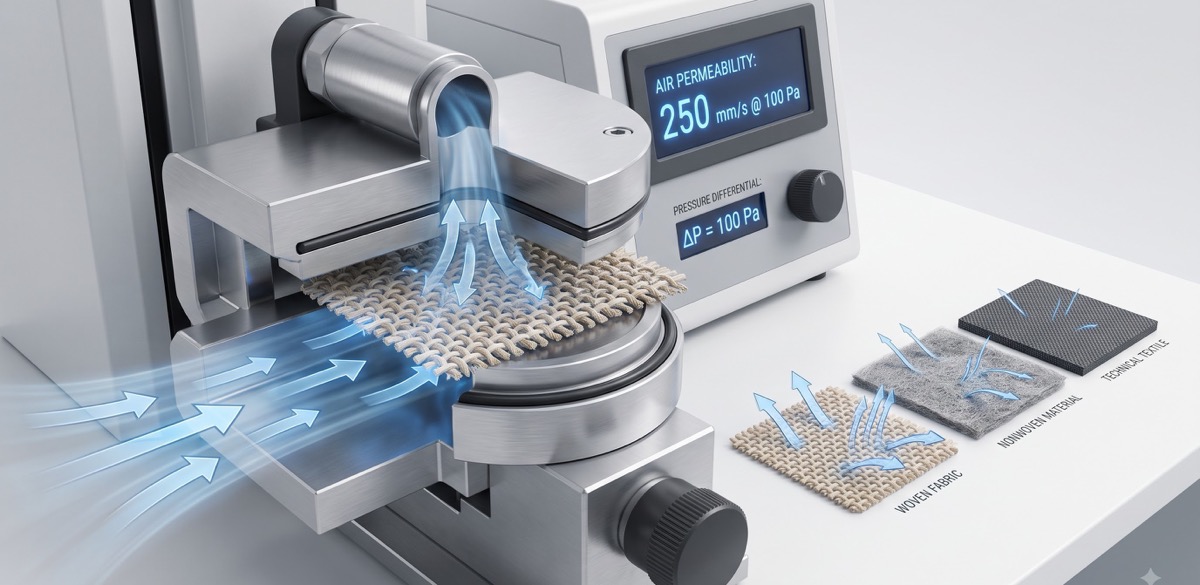
An Air Permeability Tester works by securely clamping a specimen over a known test opening, creating a controlled pressure difference across it, and measuring the resulting airflow. The measured airflow is then related to the exposed test area so laboratories can report the material's permeability under specified conditions.
A modern automatic test generally follows this measurement principle: the specimen is positioned over the test head and securely clamped, the required pressure difference is selected, the airflow system creates pressure across the specimen, air passes through the material's pores and openings, sensors measure the airflow or related parameter, and the instrument calculates and displays the result.
For example, the Apple Electroniks APT/E Automatic Air Permeability Tester has a standard test area of 20 cm², optional areas from 5 to 100 cm², a measuring range of 0.2–12,000 mm/s, and stated measurement accuracy of ≤ ±2%. The instrument also provides eight selectable reporting units, including mm/s, L/m²/s, cm³/cm²/s and cfm.
This illustrates why the test conditions must accompany the numerical result: airflow data from different test areas, pressure settings or methods should not be assumed to be directly comparable.
Which Materials Can Be Tested for Air Permeability?
Air permeability testing can be applied to most porous materials through which measurable airflow can be established, provided the selected instrument and standard are appropriate. Common examples include woven and knitted fabrics, nonwovens, coated textiles, filtration media, technical textiles, paper, membranes and selected porous industrial materials.
ISO 9237 explicitly covers most types of fabrics, including industrial fabrics for technical purposes, nonwovens and made-up textile articles that are permeable to air. ISO states that the 1995 edition was reviewed and confirmed in 2023, so it remains current.
Typical applications include woven fabrics such as shirting, workwear, upholstery and industrial fabrics; knitted fabrics for sportswear and breathable apparel; nonwovens for hygiene products, filtration layers and technical substrates; technical textiles such as automotive materials, geotextiles and filtration media; coated materials where controlled airflow is part of the performance requirement; paper and board when tested using an appropriate paper-specific method; and membranes where porosity or air resistance must be characterised.
For nonwovens specifically, ISO 9073-15:2007 is only 3 pages long but defines a dedicated method applicable to most nonwovens, including laminates and both low- and high-basis-weight materials.
The important principle is to choose the test standard first and the instrument configuration second, rather than using one test condition for every material.
Which Standards Are Used for Air Permeability Testing?
The most important air permeability standards include ASTM D737 for textile fabrics, ISO 9237 for fabrics and technical textiles, ISO 9073-15 for nonwovens, and ISO 5636-5 for Gurley testing of paper and board. The applicable method should be selected according to material, customer specification and market requirements.
| Standard | Main application | Scope |
|---|---|---|
| ASTM D737-18(2023) | Textile fabrics | Woven, knitted, nonwoven, layered, pile and other fabrics |
| ISO 9237:1995 | Fabrics | General and industrial/technical fabrics, nonwovens |
| ISO 9073-15:2007 | Nonwovens | Airflow perpendicular through nonwoven material |
| ISO 5636-5:2013 | Paper & board | Gurley air permeance / air resistance method |
ASTM lists D737-18(2023) as the active edition of its air-permeability method. ISO 9237:1995 remains current after confirmation in 2023, while ISO 9073-15:2007 remains the ISO method specifically addressing air permeability of nonwovens.
ISO 5636-5:2013 is different: it specifies the Gurley method for paper and board and covers materials with air permeance from 0.1 to 100 µm/(Pa·s) when tested with the Gurley apparatus. ISO confirmed that edition again in 2024. Always verify the current edition and the customer's exact specification before testing.
How Is an Air Permeability Test Performed?
An air permeability test is performed by conditioning the specimen as required, selecting the specified test area and pressure, clamping the material without leakage or distortion, establishing the pressure difference and recording the resulting airflow. Multiple measurements are normally taken at representative specimen locations according to the governing standard.
A practical workflow is: identify the test standard (ASTM D737, ISO 9237, ISO 9073-15 or another specification); condition the specimens per the applicable method — ASTM D1776/D1776M covers conditioning and testing of textiles when conditioning is required; select the correct test area prescribed by the standard or product specification; set the required pressure difference, since airflow changes with pressure; position the specimen flat, avoiding wrinkles, unintended stretching or damaged areas unless those areas are deliberately being evaluated; clamp the specimen securely, since edge leakage can artificially increase measured airflow; run the measurement and allow the instrument to establish the specified pressure; repeat at the required locations; and calculate and report the result using the units and statistical treatment required by the method.
Automatic systems reduce several manual operations. The Apple Electroniks APT/Auto, for example, uses automatic nozzle shifting and can generate Excel reports after testing.
How Should Air Permeability Test Results Be Interpreted?
A higher air-permeability value generally means that more air passes through the material under the specified test conditions, while a lower value indicates greater resistance to airflow. Results should only be compared when the pressure difference, test area, units, specimen conditioning and test method are equivalent.
Higher air permeability may indicate a more open fabric construction, larger or more numerous pores, greater ventilation potential, or lower resistance to airflow. Lower air permeability may indicate tighter construction, smaller effective pores, coating or finishing that restricts airflow, or higher resistance to air passage.
The numerical result alone does not determine product quality. A filter material may deliberately require restricted airflow characteristics, while breathable apparel may be engineered toward greater airflow. The relevant question is therefore: does the measured air permeability fall within the specification required for the intended application?
Units also matter. One commercial automatic instrument from Apple Electroniks supports eight selectable units, including mm/s, L/m²/s and cfm, demonstrating why a number without its unit and test conditions is incomplete. A laboratory report should therefore identify the method, specimen, test area, pressure difference, units, conditioning and reported result rather than publishing an isolated number.
What Factors Affect the Air Permeability of Fabric?
Fabric air permeability is mainly influenced by pore structure, yarn and fibre arrangement, fabric density, thickness, finishing, coatings and the pressure conditions used during measurement. Any manufacturing change that alters the number, size or geometry of pathways through the material can potentially change its measured airflow.
Important variables include fabric construction (woven, knitted and nonwoven structures create different airflow pathways), thread or loop density (tighter constructions commonly reduce open space), yarn characteristics (diameter, twist and structure influence pore geometry), material thickness (changes the path air must travel through), nonwoven basis weight and structure (fibre distribution and bonding affect airflow), coatings and finishes (can partially or substantially block pores), compression (may change thickness and pore structure), moisture and conditioning (can influence dimensions and fibre behaviour), and test pressure (directly affects measured airflow and must therefore be controlled).
Test methodology can also matter greatly in porous materials. Research comparing standardized filtration tests found that face velocity and particle charge were among the most influential experimental variables, with some methodological differences producing about a 10% increase in measured filtration efficiency. Although filtration efficiency is not the same measurement as air permeability, the study demonstrates why airflow-related test conditions must be rigorously controlled when characterising porous media.
How Do ASTM D737, ISO 9237 and ISO 9073-15 Differ?
ASTM D737 and ISO 9237 are broad fabric air-permeability methods, while ISO 9073-15 is specifically written for nonwovens. All are based on measuring airflow through a defined material area, but their scopes and prescribed procedures differ, so laboratories should not treat the standards as interchangeable without checking the specification.
| Factor | ASTM D737 | ISO 9237 | ISO 9073-15 |
|---|---|---|---|
| Primary material | Textile fabrics | Fabrics | Nonwovens |
| Woven fabrics | Yes | Yes | Not primary scope |
| Knitted fabrics | Yes | Yes | Not primary scope |
| Nonwovens | Yes | Yes | Yes — dedicated method |
| Technical/industrial fabrics | Yes | Yes | Nonwoven technical materials |
| Current reference | D737-18(2023) | ISO 9237:1995 | ISO 9073-15:2007 |
ASTM D737 explicitly includes airbag fabrics, blankets, napped fabrics, layered fabrics and pile fabrics, in addition to woven, knitted and nonwoven structures. ISO 9237 similarly has broad coverage and specifically identifies industrial fabrics for technical purposes.
ISO 9073-15 is more focused. It measures airflow passing perpendicularly through a given area and applies specifically to most nonwovens, including treated and untreated laminates. This is why purchasing a tester based solely on maximum airflow range can be a mistake: standard compatibility is equally important.
What Is the Difference Between Automatic and Gurley Air Permeability Testing?
Automatic airflow testers measure airflow through a specimen while controlling differential pressure, whereas a Gurley tester determines the time required for a defined volume of air to pass through the material. Automatic systems are commonly suited to textiles and nonwovens; Gurley instruments are particularly associated with paper, board and similar materials.
| Feature | Automatic Air Permeability Tester | Gurley-Type Tester |
|---|---|---|
| Primary measurement | Airflow at controlled pressure | Time for defined air volume |
| Typical materials | Fabrics, nonwovens, technical textiles | Paper, board, membranes |
| Typical standards | ASTM D737, ISO 9237 | ISO 5636-5 |
| Operation | Electronic/automatic | Gurley densometer principle |
| Useful for | Textile QC and multi-material labs | Paper/board air resistance |
ISO 5636-5:2013 defines the Gurley method and applies to paper and board within an air-permeance range of 0.1–100 µm/(Pa·s). The Apple Electroniks APTG Gurley Type Air Permeability Tester uses a 567 g inner cylinder, has a 28.6 mm² test area, and provides stated timing accuracy of ±0.1 seconds.
For textile laboratories working primarily to ASTM D737 or ISO 9237, an automatic airflow instrument is generally the more relevant configuration.
How Do You Choose the Right Air Permeability Tester?
Choose an Air Permeability Tester by matching the instrument to your required test standards, materials, permeability range, pressure range, test areas, accuracy and reporting workflow. A machine with impressive specifications is not necessarily suitable if it cannot reproduce the method required by your customer, laboratory or product specification.
Before purchasing, evaluate the required standards (ASTM D737, ISO 9237, ISO 9073-15, etc.), material types, expected permeability range, available pressure range, test-head areas, measurement units, instrument accuracy, automatic versus manual operation, data storage and reporting, calibration and verification requirements, and service and technical support.
For example, the APT/E Automatic Air Permeability Tester offers 0.2–12,000 mm/s measurement, a 0–1,000 Pa pressure-difference range, standard 20 cm² test area and stated ≤±2% accuracy.
The higher-specification APT/Auto Air Permeability Tester extends test pressure to 10–3,500 Pa, provides five available test-head sizes from 5 to 100 cm², and supports automated Excel reporting plus USB/LAN connectivity.
For paper and board testing to ISO 5636-5, the Gurley-type APTG represents a different measurement approach altogether.
What Common Mistakes Cause Incorrect Air Permeability Results?
The most common air-permeability testing errors come from poor specimen sealing, incorrect pressure or test area, inconsistent conditioning, unsuitable instrument ranges and comparing results obtained under different methods. Reliable testing requires controlled specimen preparation and test conditions as well as a correctly configured and verified instrument.
Watch for these problems: air leaking around the specimen rather than passing through it; wrinkled specimens that do not seal correctly; stretching flexible fabric during clamping; testing damaged or non-representative areas; using the wrong pressure difference; selecting an incorrect test-head area; ignoring specimen conditioning requirements; comparing values expressed in different units without proper conversion; comparing ASTM and ISO results without checking whether test conditions match; and using a tester outside its validated measurement range.
Leakage is particularly important. ISO's Gurley standard explicitly notes that its method is unsuitable for rough-surfaced materials that cannot be securely clamped to avoid leakage. For routine QC, laboratories should also use appropriate reference or calibration procedures and record the method and test conditions with every result.
Air Permeability Testing as Part of Textile Quality Control
Air permeability testing is most valuable when treated as one component of a wider material-performance programme rather than an isolated measurement. Depending on the product, manufacturers may need to combine airflow testing with strength, abrasion, water resistance, moisture transmission, dimensional stability or other tests to understand actual end-use performance.
For example, breathable outdoor fabric may need both airflow and water-related performance testing. A filtration nonwoven may require airflow data alongside filtration-related properties. Automotive technical textiles may combine permeability requirements with abrasion, strength, flammability and durability specifications. This distinction is important because air permeability and water permeability are not equivalent properties.
Apple Electroniks therefore groups air, water and vapour permeability instruments within a broader permeability testing equipment range covering textiles, nonwovens, paper, packaging materials, films, membranes and technical fabrics.


